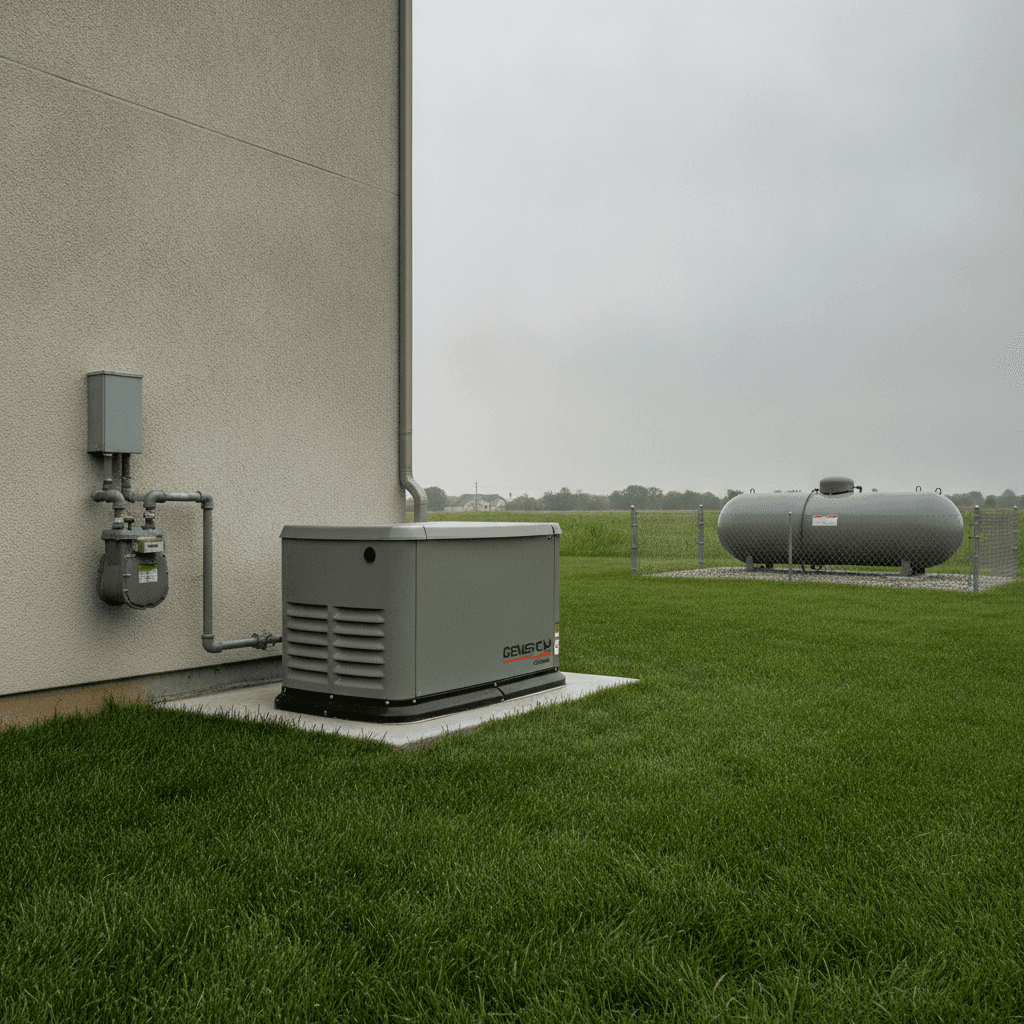
Natural gas means unlimited runtime and no tank, but a small output derate. Propane works when the gas grid fails, if the tank is sized right.
Setup Type
Quick answer: Natural gas gives a standby generator effectively unlimited runtime with no tank to fill, but air-cooled units lose about 4.5 to 11 percent of their rated output on natural gas versus propane depending on the model, and they stop if the gas grid goes down. Propane works when the gas infrastructure fails and stores for years, but a 22kW standby at half load burns about 2 to 2.5 gallons an hour, so tank size decides how many days you get. On current EIA prices natural gas is the cheaper fuel per hour, roughly $4.26 against $6.55 at half load. If you have a gas line and your outages are grid-only, natural gas is the low-hassle default. If you want fuel you control, propane earns its tank.
Best for
Standby and dual-fuel buyers choosing a fuel before the install, especially in storm country where the gas grid itself can fail.
Wrong fit
Buyers who have not yet chosen between standby and portable, or who still need to size the unit.
Tradeoff
Natural gas trades a little output and grid dependence for never handling fuel. Propane trades tank logistics for fuel you own and can store.
Natural gas gives a standby generator effectively unlimited runtime with no tank to fill, but air-cooled units lose about 4.5 to 11 percent of their rated output on natural gas versus propane depending on the model, and they stop if the gas grid goes down. Propane works when the gas infrastructure fails and stores for years, but a 22kW standby at half load burns about 2 to 2.5 gallons an hour, so tank size decides how many days you actually get.
That is the whole decision in two sentences. The rest is matching it to your outage pattern and your property. We don't sell generators. We save you from buying the wrong one, and choosing the wrong fuel is how people end up with a generator that either can't reach its rated output or runs a tank dry three days into a week-long outage.
If you have not yet chosen standby over portable, read standby vs portable first. If you still need to size the unit, what size generator do I need comes before fuel, because the size sets how much fuel you burn.
Quick Answer: Natural Gas vs Propane at a Glance
Factor
Natural gas (NG)
Propane (LP)
Runtime
Effectively unlimited
Limited by tank size
Tank needed
No
Yes, owned or rented
Rated output, Generac 22kW
21 kW
22 kW
Burn rate at half load, Generac 22kW
221 ft3/hr
2.45 gal/hr
Fuel cost at half load
About $4.26/hr
About $6.55/hr
Works if gas grid fails
No
Yes
Fuel storage life
Not applicable, piped
Stores for years
Refill logistics
None
Schedule deliveries
Best for
Grid-only outages, gas line present
Grid failures, no gas line, fuel control
Both fuels run the same standby engine well. The choice is about what fails in your area, whether you have a gas line, and how many days of outage you are planning for.
How we got the numbers, and when
The output and burn figures are read off Generac's current air-cooled spec sheet covering the 22, 24, 26 and 28 kW Guardian units, part number A0005151077, revision C dated April 29, 2026, not estimated. The fuel prices are EIA's. Propane is EIA's last published weekly residential price, $2.674 a gallon for the week ending March 30, 2026, because that survey only runs October through March and resumes on October 7, 2026. Natural gas is a 12-month average of EIA's monthly residential series, $19.28 per thousand cubic feet across July 2025 through June 2026, because the single most recent month, June 2026 at $23.26, is a summer peak that would flatter propane. Checked August 16, 2026.
Natural Gas: Unlimited Runtime, One Dependency
Natural gas is the low-hassle default, and for many homeowners it is the right call the moment they confirm a gas line reaches the unit.
The upside: no tank, no refills
A natural-gas standby is piped straight into your home's gas supply. There is no tank to install, no delivery to schedule, and no fuel to store or stabilize. When the power drops, it starts and runs, for hours or for a week, without anyone topping it off. For the buyer who wanted this handled, that is the whole appeal, and it is a real advantage. This is why natural gas is the default when the infrastructure is already there.
The derate: about 4.5 to 11 percent less output
Here is the tradeoff nobody mentions on the sticker. Natural gas carries far less energy per cubic foot than propane, so the same engine makes less power on it. Generac and Kohler both work from the same rule of thumb on their own spec sheets: about 1,000 Btu per cubic foot for natural gas against about 2,500 for propane.
We read four manufacturers' current air-cooled spec sheets rather than estimating. Here is what they actually print.
Model
Rated on LP
Rated on NG
Derate
Generac Guardian 22kW (current)
22 kW
21 kW
4.5%
Generac Guardian 24kW (current)
24 kW
22.5 kW
6.3%
Generac Guardian 26kW (current)
26 kW
24 kW
7.7%
Generac Guardian 28kW (current)
28 kW
25 kW
10.7%
Kohler 26RCA
26 kW
24 kW
7.7%
Kohler 20RCA
20 kW
18 kW
10.0%
Champion aXis 22kW
22,000 W
19,800 W
10.0%
Champion aXis 14kW
14,000 W
12,500 W
10.7%
Cummins QuietConnect RS20A
20 kW
18 kW
10.0%
So the honest planning band is about 4.5 to 11 percent, and it is model-specific rather than a fixed rule.
Two things in that table are worth stopping on. First, Generac has closed most of the gap on its current air-cooled units. If you have read that a 22kW Generac makes 19.5kW on natural gas, that was the previous generation. Generac's spec sheet dated April 29, 2026 rates the current 22kW at 21kW on gas. Anyone still quoting 19.5 is working from an old sheet, and we were too until we re-read it.
Second, the derate is not uniform across brands. Kohler's 20RCA, Champion's aXis units and the Cummins RS20A all still lose a full 10 percent. So the number to plan around is the one on the spec sheet for the exact model you are buying, not a category average. One footnote: on Kohler's own sheet the three-phase configurations of the same machine are rated identically on both fuels, so this is partly a single-phase-rating artifact rather than a law of physics.
The buyer-fit read: size the generator with that derate in mind and natural gas is a fine choice, because the lost output rarely matters. Just do not buy a unit that only clears your load on its propane rating and then run it on gas. Size for the fuel you will actually use.
The one failure mode: the gas grid
Natural gas has a single weakness, and in storm country it is not theoretical. If the event that takes your power also disrupts the gas grid, from a major earthquake, a severe freeze, or infrastructure damage, your "unlimited" fuel supply is gone. For most grid outages the gas keeps flowing and this never comes up. If you live where the gas system itself can fail, that risk is exactly why the next buyer chooses propane.
Propane: Fuel You Control, Tank Math You Own
Propane is the answer for the buyer who wants fuel they can see and store, and for anyone without a gas line. It comes with homework: the tank, and the math on how long it lasts.
The upside: works when the gas grid fails, stores for years
Propane sits in your own tank on your own property, independent of any utility. It works when the gas grid is down, and it stores for years without degrading, unlike gasoline. If your worst case is a regional event that takes gas and power together, or you simply have no natural gas service, propane keeps running. That independence is the reason to choose it.
The tank math: gallons per hour vs days of outage
This is where propane buyers get surprised, so let's do the arithmetic with published burn rates instead of guesses. Here is what four manufacturers print for a 20kW to 22kW air-cooled unit on propane:
Model
Half load
Full load
Generac Guardian 22kW
2.45 gal/hr
3.71 gal/hr
Kohler 20RCA
2.25 gal/hr
3.74 gal/hr
Champion aXis 22kW
2.0 gal/hr
3.6 gal/hr
Cummins QuietConnect RS20AC
1.9 gal/hr
3.2 gal/hr
So the planning band is about 2 to 2.5 gallons an hour at half load, and most homes rarely hit full load. Propane containers are typically filled to 80 percent of capacity to leave room for thermal expansion, per the Propane Education and Research Council, so a "500-gallon" tank holds about 400 usable gallons. Run the numbers at 2.0 to 2.45 gallons an hour:
Tank size
Usable at 80%
Hours at half load
Days
250 gallon
about 200 gal
82 to 100
3.4 to 4.2
500 gallon
about 400 gal
163 to 200
6.8 to 8.3
1,000 gallon
about 800 gal
327 to 400
13.6 to 16.7
If your plan is a week-long hurricane outage, a 250-gallon tank runs dry before the lights come back, and a 500-gallon tank is the realistic floor. This calculation decides your tank, not the generator brand. Undersize the tank and you have a standby that quits mid-outage, the exact failure propane was supposed to prevent.
What each fuel costs to run, in dollars
The reliability half of this decision gets argued endlessly and the cost half almost never does, so here it is. This uses Generac's published 22kW burn rates against EIA prices, at half load, which is the realistic whole-house outage load.
Outage length
Natural gas
Propane
Difference
Per hour
$4.26
$6.55
$2.29
24 hours
$102
$157
$55
72 hours
$307
$472
$165
168 hours (one week)
$716
$1,101
$385
Natural gas is the cheaper fuel per hour, by roughly a third, and it never asks you to schedule a delivery. That is the real cost-effectiveness answer, and it points at natural gas for anyone who has a line.
Two honest caveats. Propane prices swing regionally far more than piped natural gas does, and EIA's propane survey is a national residential average from the end of the last heating season, so your delivered price may differ. And the propane column buys you something the gas column does not: the fuel is already on your property when the utility is not delivering. For a week-long outage that certainty costs about $385. Whether that is expensive depends entirely on whether your gas line is the thing that fails.
Tank rental vs purchase and refill logistics
You can rent the tank from your supplier or buy it outright, and the tradeoff is about pricing power, not just up-front cost.
Maine's Governor's Energy Office puts the rental case plainly in its consumer guide: pressurized propane tanks are expensive to purchase, so most households let the retailer own the tank, and the retailer recovers that cost through the price of the fuel. The same guide lists the fees to ask about before you sign: annual tank rental, annual leak detection and safety inspection, delivery, and tank removal plus fuel pump-out if you ever switch suppliers. That last one is the trap. Maine law bars a propane dealer from filling a tank owned by another company, and other states have comparable rules, so a rented tank means one supplier sets your per-gallon price for as long as you keep it.
Wisconsin's Department of Agriculture, Trade and Consumer Protection frames the other side: owning a tank lets you compare prices between marketers, but it also brings real maintenance costs and responsibilities.
We are not going to publish a national dollar figure for either path, because no primary source publishes one. Get two written quotes, one rental and one purchase, and make each supplier show the annual fees and the per-gallon price side by side. Either way, you are now scheduling deliveries and watching a gauge. For the buyer who values fuel independence, that tradeoff is worth it. For the buyer who never wants to think about fuel, it is the reason to stay on natural gas.
Dual-Fuel Portables: The Flexible Middle
If you are in the portable lane rather than standby, dual-fuel sidesteps the whole either-or. A dual-fuel portable runs on both gasoline and propane, so you get gasoline's higher output when you want it and propane's forever-storage and clean starts when you don't. Most owners store the machine on propane to dodge the stale-gas no-start, and keep gasoline as the high-output option. It is the flexible pick for a home-backup portable, and the reliability side is covered in generator maintenance cost. For specific units, see the best portable generators for home backup.
How to Choose by Your Situation
Choose natural gas if you have a gas line to the unit, your outages are ordinary grid failures, and you never want to handle fuel. Size the generator with your model's published derate in mind and you have the lowest-hassle backup power there is, and the cheaper one per hour. This fits most suburban homeowners.
Choose propane if you have no natural gas service, or you live where a big event could take gas and power together, and you want fuel you control. Commit to the tank math: plan a 500-gallon tank or larger for multi-day outages, and factor in delivery scheduling. This fits rural properties and storm-belt homeowners planning for the long outage.
Choose dual-fuel if you are buying a portable and want maximum flexibility, or a machine that stores cleanly on propane but can pull higher output on gasoline. It is the practical middle for home backup that is not a whole-house standby.
Is a natural gas or propane generator better for a home?
It depends on your gas line and your outage pattern. Natural gas gives unlimited runtime with no tank and no refills, which fits most suburban homes with existing gas service. Propane works when the gas grid fails and stores for years, which fits rural homes with no gas line and anyone planning for long, severe outages. If you have a gas line and see ordinary grid outages, natural gas is the low-hassle default.
How much power do you lose running a generator on natural gas?
About 4.5 to 11 percent, read off four manufacturers' current spec sheets rather than estimated, and it varies a lot by model. Generac's current spec sheet, revised April 29, 2026, rates the Guardian 22kW at 22 kW on propane and 21 kW on natural gas, a 4.5 percent derate, rising to 10.7 percent on its 28kW. Kohler's 20RCA, Champion's 22kW aXis and the Cummins RS20A all lose a full 10 percent. The widely repeated figure of 19.5 kW on gas for a 22kW Generac is the previous generation and is now out of date. The cause is energy density: manufacturers work from about 1,000 Btu per cubic foot for natural gas against about 2,500 for propane. Size the unit for the fuel you will actually run.
How long will a propane generator run on a 500-gallon tank?
Manufacturers publish 1.9 to 2.45 gallons an hour at half load for a 20kW to 22kW air-cooled unit, and a 500-gallon tank holds about 400 usable gallons at the 80 percent fill. At 2.0 to 2.45 gallons an hour that is 163 to 200 hours, or 6.8 to 8.3 days. A 250-gallon tank gives 3.4 to 4.2 days and a 1,000-gallon tank 13.6 to 16.7 days. For a week-long outage, plan on a 500-gallon tank as the realistic floor.
Does propane last longer in storage than gasoline?
Yes, by a wide margin. Propane stores for years without degrading, while gasoline starts to break down in about a month and can varnish a carburetor within a few months without a stabilizer. That storage advantage is a big reason buyers choose propane or a dual-fuel portable.
What happens to a natural gas generator if the gas line fails?
It stops, because it has no fuel reserve of its own. For ordinary grid outages the gas keeps flowing and this is a non-issue. But in a major event that damages gas infrastructure, a freeze, an earthquake, severe storm damage, a natural gas generator can lose its supply along with the power. If you live where that risk is real, propane's on-site tank is the reason to choose it.
Should I rent or buy my propane tank?
Renting means the supplier owns and maintains the tank, but it also means only that supplier can legally fill it, so they set your per-gallon price. Maine's state propane guide notes that most households rent because tanks are expensive to buy, and that the retailer recovers the tank cost through the fuel price. Owning lets you shop marketers on price, which Wisconsin's consumer agency confirms, but you take on the maintenance and the responsibility. No public source publishes a reliable national price for either, so get one rental quote and one purchase quote in writing, with the annual fees and the per-gallon price both shown. Buy if you plan to stay in the home several years, rent if you might move soon.
Can one generator run on both natural gas and propane?
Yes, and dual-fuel is common on both standby and portable units. A standby can be configured for natural gas or propane at install, and many dual-fuel portables switch between gasoline and propane on the fly. For home backup, a dual-fuel portable is the flexible choice: propane for clean storage and long shelf life, gasoline for higher output when you need it.
What we could not verify
Propane tank rental and purchase prices. No primary source publishes a national figure for either. We removed the dollar ranges this page used to carry rather than keep numbers we cannot stand behind, and replaced them with the fee categories two state agencies actually name.
EIA's propane price is off-season. The Weekly Heating Oil and Propane Prices survey only runs October through March. The $2.674 a gallon used here is the last published value, for the week ending March 30, 2026, and the survey resumes October 7, 2026. Propane also swings regionally more than piped gas.
Generac's older spec sheets contradict its current one. The 2022 sheet for the 20/22/24 kW line rates the 22kW at 19,500 W on natural gas and 2.53 gal/hr at half load. The April 2026 sheet rates the same nominal size at 21 kW and 2.45 gal/hr. We use the current sheet, and flag it because a lot of published advice still runs on the old numbers.
Elevation and temperature derates are not in the table above. Manufacturers publish altitude deratings separately, and this page does not attempt them.
These guides are built from manufacturer documentation, public specifications, primary research where health claims matter, and repeated buyer questions that show up in real ownership and installation decisions.
Manufacturer responses can clarify pricing bands, warranty terms, support footprint, or common mistakes. They do not move a page up the shortlist on their own.