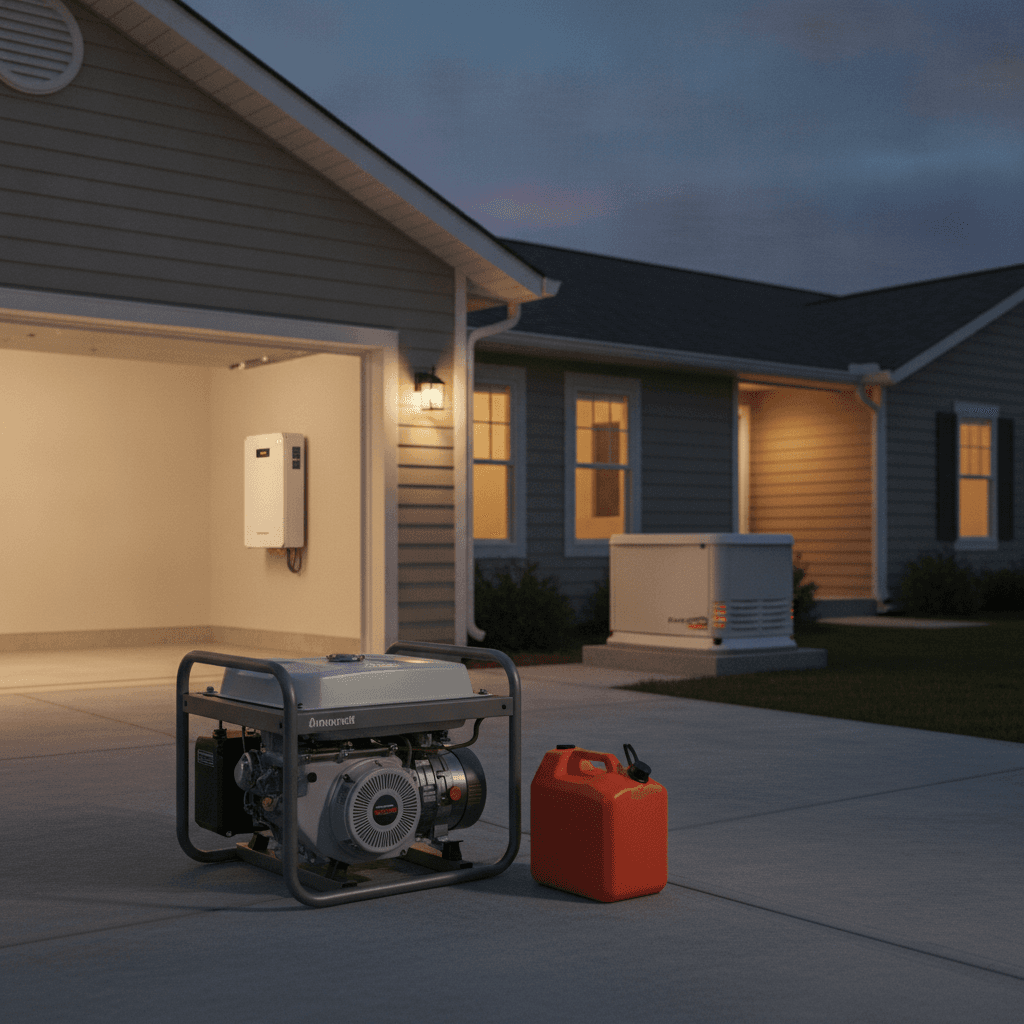
Generator vs Home Battery: When Each Beats a Standby
Budget and rentals favor a portable. Short, silent outages favor a battery. Multi-day outages favor a standby. Here is exactly when each wins.
Setup Type
Quick answer: If you are about to sign for a whole-house standby, four things should make you stop and look at a portable or a battery instead: a hard budget ceiling, renting or otherwise not wanting a permanent install, outages that run hours instead of days, or a constraint like an HOA ban or no gas line. A portable plus interlock covers the budget and rental case at $1,500 to $3,500 all-in. A battery covers the short-outage, HOA, and no-gas-line case at $10,000 to $30,000 installed. Outside those triggers, and especially for multi-day outages, a standby at $12,000 to $18,000 installed still wins on hands-off runtime.
Best for
Buyers weighing a home battery against a generator, wondering whether they need one, the other, or both.
Wrong fit
Buyers deep into battery sizing and solar pairing. That is the sister site's home turf.
Tradeoff
A battery is silent, clean, and instant, and it runs out. A generator is loud and needs fuel, and it never runs out as long as you feed it.
Here is the split, with no hedging. For short outages measured in hours, a home battery wins: silent, indoor-safe, no fuel to store, and it switches over the instant the grid drops. For outages measured in days, a generator wins, because you can refuel it as long as the outage lasts and a battery runs down. That is the whole decision in two sentences.
The costs sit far apart, so see them together. A standby generator is $12,000 to $18,000 installed. A home battery is $10,000 to $30,000 installed. A portable plus an interlock kit is $1,500 to $3,500. We cover the generator side here and hand you to our sister site homebattery.guide for the battery side, because doing both subjects justice takes two sites, not one padded page.
Quick Answer: Generator vs Home Battery
Home battery
Portable generator
Standby generator
All-in cost
$10,000-$30,000 installed
$1,500-$3,500
$12,000-$18,000 installed
Best for
Short outages, hours
Occasional outages, hours to days
Multi-day outages
Runs for days
Only if solar refills it
Yes, if you refuel
Yes, on the gas line
Noise
Silent
Loud
Quieter, weekly self-test
Indoor safe
Yes
Never, carbon monoxide
Sits outside
Switchover
Instant, automatic
Manual, a few minutes
Automatic, seconds
Fuel
Electricity, plus solar
Gasoline or propane
Natural gas or propane
Read it by duration. If your outages are short, look hard at a battery. If they are long, a generator is the tool. If they are both, which is common, the answer might be one of each, and we get to that below.
When a Portable or a Battery Beats a Standby Installation
If you are already pricing a whole-house standby, four things should make you stop and check a cheaper or quieter lane first, before you sign anything.
If this is true
Choose instead
Why
The $12,000-$18,000 installed price is more than the project is worth to you
Portable plus interlock, $1,500-$3,500 all-in
Same essential-circuits coverage in an outage, a fraction of the cost
You rent, or you do not want a permanent pad and gas line on the property
Portable plus interlock
Nothing bolted down, nothing left behind for a landlord or a sale
Your outages are hours, not days, and someone is usually home to run a machine
Portable plus interlock, or a battery if quiet matters more than price
A standby's main edge, hands-off multi-day runtime, goes unused
An HOA or deed restriction bans a running generator, or you have no gas line
Home battery, $10,000-$30,000 installed
Silent and indoor-safe, no combustion, nothing to run afoul of a rule
You want quiet, indoor-safe backup and can live with a countdown timer
Home battery
Instant, automatic switchover with none of a generator's noise or fumes
Your outages regularly run multiple days, or nobody is home to refuel
Standby generator still wins
It starts itself and keeps running on the gas line as long as the outage lasts
Outside those five triggers, a standby earns its price. Multi-day outages, a well pump you cannot live without, medical equipment, or a household that travels are exactly the case a standby is built for, and the real cost of a whole-house generator is worth reading before you get a quote either way.
The Clean Split: Hours vs Days
A battery and a generator solve the same problem from opposite ends.
A battery is stored energy. It is excellent for the first few hours: no noise, no fumes, nothing to start, safe to sit right against the house because it emits nothing. Power blinks out, the lights never even flicker, and you may not know the grid is down until a neighbor mentions it. For the short, common outages most homes actually get, that experience is hard to beat.
And most outages really are short. EIA's reliability data for 2024 puts the average US customer at 2.2 hours without power across the year once major storm events are excluded. Include the major events and the same average jumps to 11.0 hours, the worst year in a decade, with hurricanes Beryl, Helene and Milton accounting for 80 percent of the total. That split is the battery-versus-generator question stated as data: a battery is sized for the 2.2 hours, a generator for the other nine.
A generator makes energy on the spot from fuel. It is louder and it needs feeding, but that is also its strength. As long as you can get gasoline, propane, or natural gas to it, it runs. Hour 60 of an outage looks the same to a generator as hour 2. That is exactly where a battery is struggling.
The decision rule, as criteria rather than prose
If this is true
Choose
Outages are hours and the gap between your state's storm and non-storm figures is small
Battery
An HOA or local rule bans a running generator
Battery
No gas line and you do not want fuel deliveries
Battery
You already have solar, or will add it
Battery, which solar refills each day
Outages run multiple days after storms
Generator
You have a well pump, and no water means no toilet
Generator
Nobody is home during outages, and you need automatic switchover for days
Standby generator
Frequent short blips plus a rare multi-day storm outage
One of each
Budget is the binding constraint
Portable plus interlock, the cheapest lane by a wide margin
A battery without solar is a countdown timer
This is the line vendors soften and we will not. A home battery that is not paired with solar holds a fixed amount of energy. In a long outage it counts down and then it is done, often within a day of backing up a normal house, sooner if you run heavy loads. Pair it with solar and it refills each sunny day, which changes the math a lot. Without solar, plan for a battery to cover hours, not a hurricane.
A generator needs fuel and upkeep
The generator's weakness is the mirror image. It only runs if you feed it. A portable needs someone home to refuel it every 8 to 12 hours or so. A standby needs a gas line or a propane tank, a weekly self-test, and a $200 to $400 a year service habit. And a generator is never run indoors or in a garage, because CPSC's published figure is that more than 80 consumers a year die of carbon monoxide poisoning caused by portable generators, with the agency's May 2026 estimates putting the 2020 to 2022 average at 98 a year, most of them in the days after a storm. The safe-placement rules are not optional, and we keep them product-free in never run a generator indoors.
What Each One Costs Installed
Option
All-in installed
What it buys you
Portable + interlock
$1,500-$3,500
Days of backup if you refuel it, cheapest by far
Standby generator
$12,000-$18,000
Hands-off multi-day backup on the gas line
Home battery
$10,000-$30,000
Silent, indoor-safe, instant, hours unless paired with solar
For the generator, the number to plan around is always the installed one. A standby machine is a few thousand dollars as a box, but the pad, gas line, transfer switch, permits, and two trades bring it to $12,000 to $18,000. The install costs about as much as the machine. The full breakdown is in the real cost of a whole-house generator.
Battery pricing swings even wider, $10,000 to $30,000 depending on how many kilowatt-hours you stack and whether you add solar. That is the sister site's home turf, and it is worth reading before you commit.
When the Answer Is Genuinely Both
For a lot of storm-belt homes, the right setup is one of each, and it is not a cop-out.
The pattern looks like this. You get frequent short blips, a few seconds to an hour, several times a month, plus the occasional multi-day outage after a big storm. A battery handles the blips perfectly, silent and automatic, so your work call and your fridge never notice. A portable, kept in the garage with some fuel, handles the rare long haul when the battery would otherwise run down. You get silence and instant switchover for the short outages that make up most of them, and refuelable endurance for the long ones.
You do not need a $15,000 standby and a $20,000 battery to do this. A right-sized battery for the daily blips plus a $2,000 portable for the hurricanes covers both jobs for far less than doing either at whole-house scale. If you are on a hurricane coast, line it up before the season with hurricane season generator prep.
For the Battery Half of This Decision
We stop at the overview on batteries on purpose. Sizing kilowatt-hours to your loads, pairing with solar, comparing the major battery systems, and reading the install quotes are their own project, and our sister site does it properly, including what a battery quote should itemize in the real cost of a home battery. If this guide has you leaning battery, go read it next, then come back and size the generator side here. The two decisions are easier together than apart, and neither site sells the hardware, so the recommendation you get on each is the one that fits your outages, not the one that pays a commission.
Still deciding among all three lanes, standby, portable, or battery? That three-way call, keyed to your outage pattern, is standby vs portable vs home battery.
Frequently Asked Questions
When is a portable generator or a home battery a better choice than a standby generator?
Four triggers should make you look at a portable or a battery before signing for a standby: a hard budget ceiling, renting or not wanting a permanent pad and gas line, outages that run hours rather than days, or a constraint like an HOA ban on running generators or no gas line at all. A portable plus interlock at $1,500 to $3,500 covers the budget and rental case. A battery at $10,000 to $30,000 installed covers the short-outage, HOA, and no-gas-line case. Outside those triggers, especially for multi-day outages, a standby at $12,000 to $18,000 installed still wins because it starts itself and keeps running on the gas line.
Is a home battery better than a generator?
For short outages, yes: a battery is silent, safe indoors, needs no fuel, and switches over instantly. For multi-day outages, no: a battery runs down while a generator keeps going as long as you feed it. The better tool is set by how long your power actually stays out, not by which technology is newer.
How long will a home battery power my house during an outage?
Without solar, usually several hours to about a day for a typical home, less if you run heavy loads like AC or electric heat. Paired with solar that recharges it each sunny day, it can stretch much further. A battery on its own is a countdown timer in a long outage, which is why generators still win the multi-day scenario. The sizing detail lives on homebattery.guide.
How much does a home battery cost installed?
Roughly $10,000 to $30,000 installed, depending on how many kilowatt-hours you stack and whether you add solar. That is in the same neighborhood as a standby generator at $12,000 to $18,000 installed, and far above a portable plus interlock at $1,500 to $3,500. Cost alone rarely decides it. Duration does.
Can a battery run my whole house like a generator?
For a while, yes, it can run whole-house loads, but only until the stored energy is gone. A generator can run those same loads for days because it refuels. If you want whole-house backup that lasts through a multi-day outage, a generator or a battery-plus-solar system is the answer, not a battery alone.
Do I need solar for a home battery to be worth it?
For short outages, no, a battery alone covers you and switches over instantly. For long outages, effectively yes, because without solar to refill it, the battery runs down and stops. If multi-day resilience is your goal and you do not want solar, a generator is usually the simpler and cheaper path.
Can I have both a battery and a generator?
Yes, and for many storm-belt homes it is the smartest setup. The battery handles frequent short blips silently and automatically. A portable handles the rare multi-day outage when the battery would run down. A right-sized battery plus a $2,000 portable covers both without paying for a whole-house version of either.
Which is cheaper, a generator or a battery?
A portable generator plus an interlock, at $1,500 to $3,500 all-in, is the cheapest backup power by a wide margin. A standby generator at $12,000 to $18,000 installed and a home battery at $10,000 to $30,000 installed are in the same five-figure neighborhood, with the battery reaching higher when you add capacity or solar.
What we could not verify
Installed price bands. The $10,000 to $30,000 battery band, the $12,000 to $18,000 standby project and the $1,500 to $3,500 portable setup are this site's own figures. The national cost aggregators that publish averages block automated retrieval, so no third-party average is quoted here.
Battery runtime per household. It depends entirely on stored kilowatt-hours and the loads you back up, which is sizing work our sister site does properly rather than something a national figure can answer.
These guides are built from manufacturer documentation, public specifications, primary research where health claims matter, and repeated buyer questions that show up in real ownership and installation decisions.
Manufacturer responses can clarify pricing bands, warranty terms, support footprint, or common mistakes. They do not move a page up the shortlist on their own.