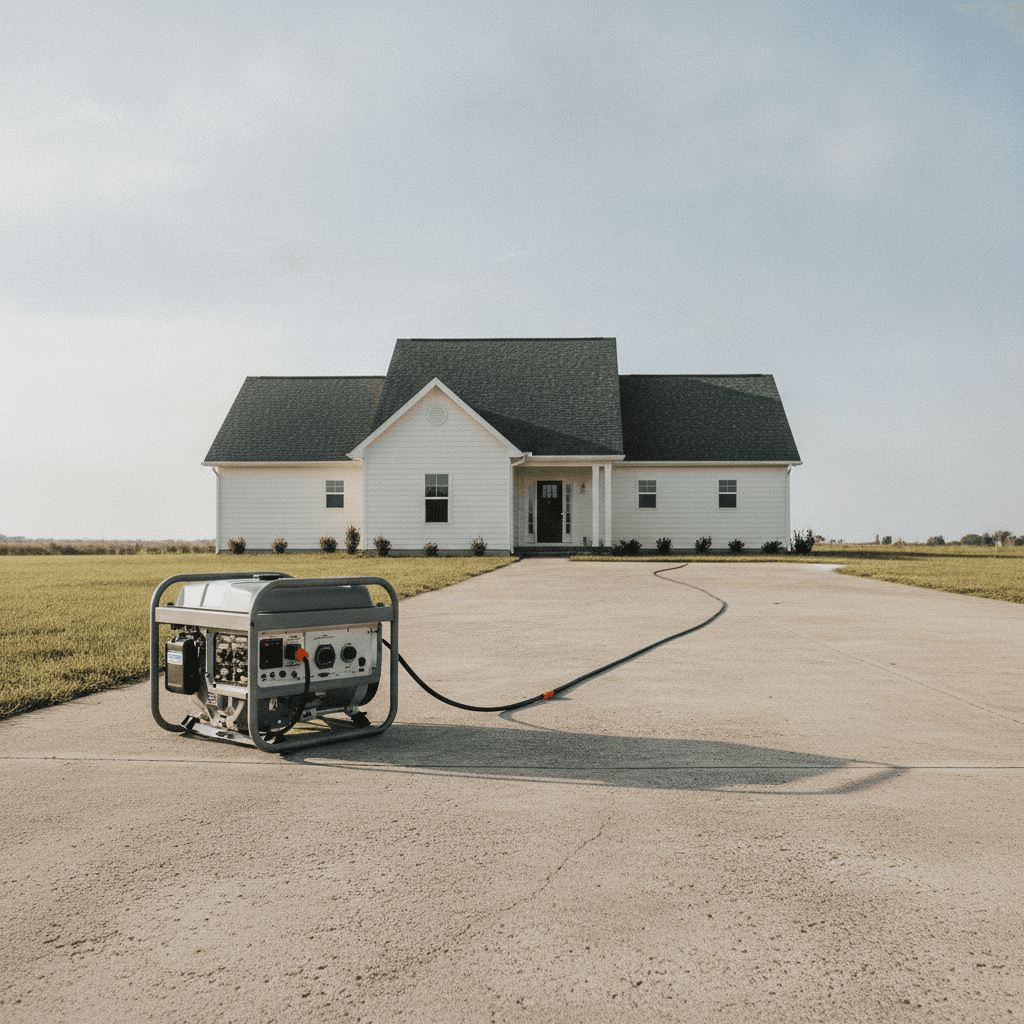
Portable generator safety per CPSC: carbon monoxide, the 20-foot rule, safe refueling, wet weather, overload, and backfeeding, served straight.
Installation
Quick answer: Run a portable generator outside only, at least 20 feet from the house, with the exhaust pointed away from doors, windows, and vents. Never run it inside a home, garage, basement, crawlspace, shed, or on a porch, even with the doors open, because the exhaust is carbon monoxide and it kills more than 80 people a year (CPSC). Put battery-operated CO alarms on every level of the house, refuel only when the engine is off and cool, and have a licensed electrician wire in an interlock or transfer switch so you never backfeed the grid.
Best for
Anyone who owns or is about to buy a portable generator and wants the full safety picture in plain terms.
Wrong fit
Buyers who only want product picks. This page has none. It is safety information, served straight.
Tradeoff
There is no safe shortcut here. Every rule trades a little convenience for not dying of carbon monoxide or burning down the garage, and it is worth it every time.
A portable generator is an engine, and its exhaust is carbon monoxide, a gas you cannot see or smell that kills more than 80 people in the United States every year (CPSC). Almost every one of those deaths is preventable, and the prevention comes down to a few plain rules. Run it outside only. Keep it at least 20 feet from the house with the exhaust aimed away. Put battery-operated carbon monoxide alarms inside.
This guide covers the full picture: carbon monoxide, placement, alarms, refueling, wet weather, overload, and backfeeding. It is served straight, with no products to sell you.
Quick Answer: Where a Generator Is Safe and Where It Is Not
Location
Safe to run a generator?
Outside, 20+ feet from the house, exhaust aimed away
Yes
Inside the house
No
Attached garage, even with the door open
No
Detached garage or shed
No
Basement or crawlspace
No
Porch or carport
No
Next to an open window, door, or vent
No
Per CPSC, never run a portable generator inside a home, garage, basement, crawlspace, or shed, or on a porch, even if the doors and windows are open. Opening them does not move enough air to prevent a lethal buildup of carbon monoxide. If you take one thing from this page, take that. The single most dangerous question gets its own page: never run a generator indoors.
Carbon Monoxide Is What Does the Killing
Carbon monoxide, or CO, is why generator safety is a life-or-death topic, not just good housekeeping. CPSC calls it the invisible killer because it is colorless and odorless and can kill in minutes. You do not smell it, you do not see it, and by the time you feel it you may already be too impaired to act.
A single portable generator produces carbon monoxide at hundreds of times the rate of a car. CPSC staff put real numbers on it: the engine behind a 5 kW generator emits a weighted average of roughly 1,500 grams of CO per hour, while an idling mid-size car emits 2.4 to 5.4 grams per hour. That is a 5 kW generator running at about 450 cars' worth of exhaust. Run one in an enclosed or partly enclosed space and the gas builds up fast.
More than 80 consumers die this way every year in the United States (CPSC). The agency's most recent statistical estimates, published in May 2026, put generators at an estimated 98 non-fire CO deaths a year averaged across 2020 through 2022, which is 41 percent of every consumer-product carbon monoxide death in the country.
The Symptoms Look Like the Flu
Early CO poisoning feels like headache, dizziness, weakness, nausea, vomiting, sleepiness, and confusion (CPSC). That list is easy to mistake for the flu or for being worn out after a storm cleanup, which is part of why it is so dangerous. People lie down, fall asleep, and do not wake up. If anyone feels these symptoms while a generator is running, get everyone outside to fresh air, then call 911.
Why the Deaths Cluster After Storms
Generator CO deaths are not spread evenly through the year. They cluster in the days after hurricanes and winter storms, when the power is out and people run generators to keep the fridge and the heat going. That is when the mistakes happen: the generator goes in the garage to stay out of the rain, or on the porch, or outside a bedroom window. Plan the safe setup before the storm, not in the dark with a dying phone. Our hurricane season generator prep guide covers the timing.
Placement: Outside Only, 20 Feet, Exhaust Away
The rule from CPSC is short. Operate portable generators outside only, at least 20 feet away from the house, and direct the exhaust away from the home and other buildings. Do not use a generator near openings to your home, including doors, windows, and vents. CPSC has recommended that 20-foot separation since 2013, and its engineering wording is 20 feet from openings that could be entered or occupied, not just 20 feet from the wall.
Twenty feet is a minimum, not a target. Farther is better, and exhaust direction matters as much as distance. A generator with its exhaust aimed at an open window is more dangerous than one a little closer with the exhaust pointed at the open yard. What does not help is ventilation. CPSC's position is explicit that deadly CO levels build in enclosed areas "even when using fans or opening doors and windows for ventilation," so airflow is never the fix. Distance is.
Why "The Door Is Open" Does Not Work
This is the belief that kills people, so it is worth stating plainly. An open garage door or window does not move enough air to clear the carbon monoxide a generator produces. The gas accumulates faster than the opening vents it, and because you cannot smell it, you get no warning that the level is climbing. The full explanation is on never run a generator indoors.
Carbon Monoxide Alarms: The Backup for What You Cannot Smell
Because your senses give you no warning, a working alarm is the backup that does. CPSC recommends installing battery-operated CO alarms, or alarms with battery backup, outside sleeping areas and on each floor of the home, and testing them monthly. It also tells buyers to check the alarm is certified to a current safety standard, UL 2034, IAS 6-96 or CSA 6.19.01. Battery power matters here: the whole point is that they work when the grid is down and the generator is running.
The alarm gap is real, not theoretical. In CPSC's own 2011 to 2021 fatality review, a CO alarm was known to be present in only 17 percent of engine-driven-tool CO deaths, and in some of those the alarm was inoperable.
Some newer portable generators add a second layer: a built-in sensor that shuts the engine off automatically when carbon monoxide builds up around the unit. CPSC tells buyers to ask retailers for it. It is built to one of two voluntary standards, ANSI/PGMA G300-2023 or UL 2201-2023, and neither is a federal requirement. When CPSC modelled both against real fatal incidents, the UL 2201 version came out stronger, because it caps the engine's CO output as well as shutting the unit down. CPSC also concluded that neither standard is adequate on its own and has proposed a mandatory rule drawing on both.
Treat the sensor as a backstop against a mistake, not as permission to run a generator closer to the house. CPSC's fatality report includes a three-person death involving a generator advertised as certified to ANSI/PGMA G300-2018. The rule is still outside only.
Refueling: Engine Off, Engine Cool
Never refuel a generator while it is running. In CPSC's words, before refueling the generator, turn it off and let it cool down, because gasoline spilled on hot engine parts could ignite. It is the fire hazard right next to the carbon monoxide hazard, and just as avoidable.
Store fuel in an approved, properly marked and vented container, away from the running generator, living spaces, and any ignition source such as a water heater pilot. CPSC's line is blunt: never store fuel for your generator in the home. OSHA adds the same rule for the jobsite version, and warns that escaping vapors from spilled fuel can travel a long way to an ignition source. Keep only what you plan to use, and rotate it so it does not go stale.
Wet Weather: Keep the Generator and Yourself Dry
Storms are wet, and generators do not mix well with water. Run the unit on a dry surface. If it has to run in the rain, use a cover or canopy made for generators, one that keeps water off while leaving the exhaust in open air. Do not improvise an enclosure that traps exhaust, and never move the generator indoors or under a carport to keep it dry. That trade, a dry machine for trapped carbon monoxide, is the fatal one.
Keep your hands dry when you touch it, and run your cords through outlets or devices with ground-fault protection (GFCI) where you can. Water plus electricity is its own hazard, separate from the exhaust.
Overload: The Safety Side of Sizing
Sizing is usually treated as a convenience question. It is also a safety question. A portable generator loaded past its rating overheats, and an overloaded unit or extension cord can start a fire or damage what is plugged into it. Do not daisy-chain extension cords, use cords rated for the load and distance, and keep the total draw under the generator's continuous rating, not its peak. Our what size generator do I need guide walks through the math.
Backfeeding: The Shortcut That Kills Line Workers
Backfeeding means powering your house by plugging a generator into an ordinary outlet, often a dryer or range outlet, with no proper switch in between. OSHA's rule is the one to remember: never attach a generator directly to the electrical system of a structure unless a qualified electrician has properly installed it with a transfer switch, because doing it without one "can energize wiring systems for great distances," which "creates a risk of electrocution for utility workers and others in the area." ESFI puts the same hazard in homeowner terms: backfeeding "can damage your home, your neighbor's home, and injure workers trying to restore power." When the grid comes back, it can also destroy your generator and start a fire.
The safe and legal way to connect a portable generator to your house wiring is an interlock kit or a transfer switch, installed by a licensed electrician. Both make it physically impossible to feed the grid and the generator into your panel at the same time. We cover what each one is, what it costs, and how to read a quote in interlock kit vs transfer switch. This is licensed-electrician work, never a do-it-yourself job.
Frequently Asked Questions
Can I run a generator in the garage if the door is open?
No. CPSC guidance is explicit: never run a portable generator inside a garage, even with the door open. An open door does not move enough air to prevent a lethal buildup of carbon monoxide, and because the gas is odorless you get no warning. Run the generator outside, at least 20 feet from the house, with the exhaust pointed away.
How far does a generator need to be from the house?
At least 20 feet, per CPSC, with the exhaust directed away from the home and away from any doors, windows, and vents. Treat 20 feet as the minimum. Farther is safer, and pointing the exhaust toward open space rather than the house matters as much as the distance.
Do I need a carbon monoxide detector if I own a generator?
Yes. CPSC recommends battery-operated CO alarms, or alarms with battery backup, outside sleeping areas and on every floor of the home, tested monthly. Because a generator runs when the power is out, battery power is the point. The alarm is your only warning for a gas you cannot see or smell.
Can I run a generator in the rain?
Only with the right protection, and never by bringing it inside. Run it on a dry surface, and if it must run in wet weather use a cover or canopy built for generators that keeps water off while leaving the exhaust in open air. Moving it into a garage, shed, or carport to stay dry is what turns a wet-weather problem into a fatal one.
Is it safe to refuel a generator while it is running?
No. Turn the generator off and let it cool before refueling (CPSC). Gasoline spilled onto a hot engine or exhaust can catch fire. Store fuel in an approved container away from the generator, living spaces, and any ignition source.
Can I plug a generator into my dryer outlet to power the house?
No. That is backfeeding, and it is both illegal and deadly. Power can flow back onto the utility line and electrocute a lineman, and it can destroy your generator when the grid returns. The legal way to connect to your house wiring is an interlock kit or transfer switch installed by a licensed electrician.
What are the symptoms of carbon monoxide poisoning?
Headache, dizziness, weakness, nausea, vomiting, sleepiness, and confusion (CPSC). They are easy to mistake for the flu. If anyone feels these symptoms while a generator is running, get everyone outside to fresh air immediately, then call 911. Do not go back in until the source is off and the space has cleared.
These guides are built from manufacturer documentation, public specifications, primary research where health claims matter, and repeated buyer questions that show up in real ownership and installation decisions.
Manufacturer responses can clarify pricing bands, warranty terms, support footprint, or common mistakes. They do not move a page up the shortlist on their own.