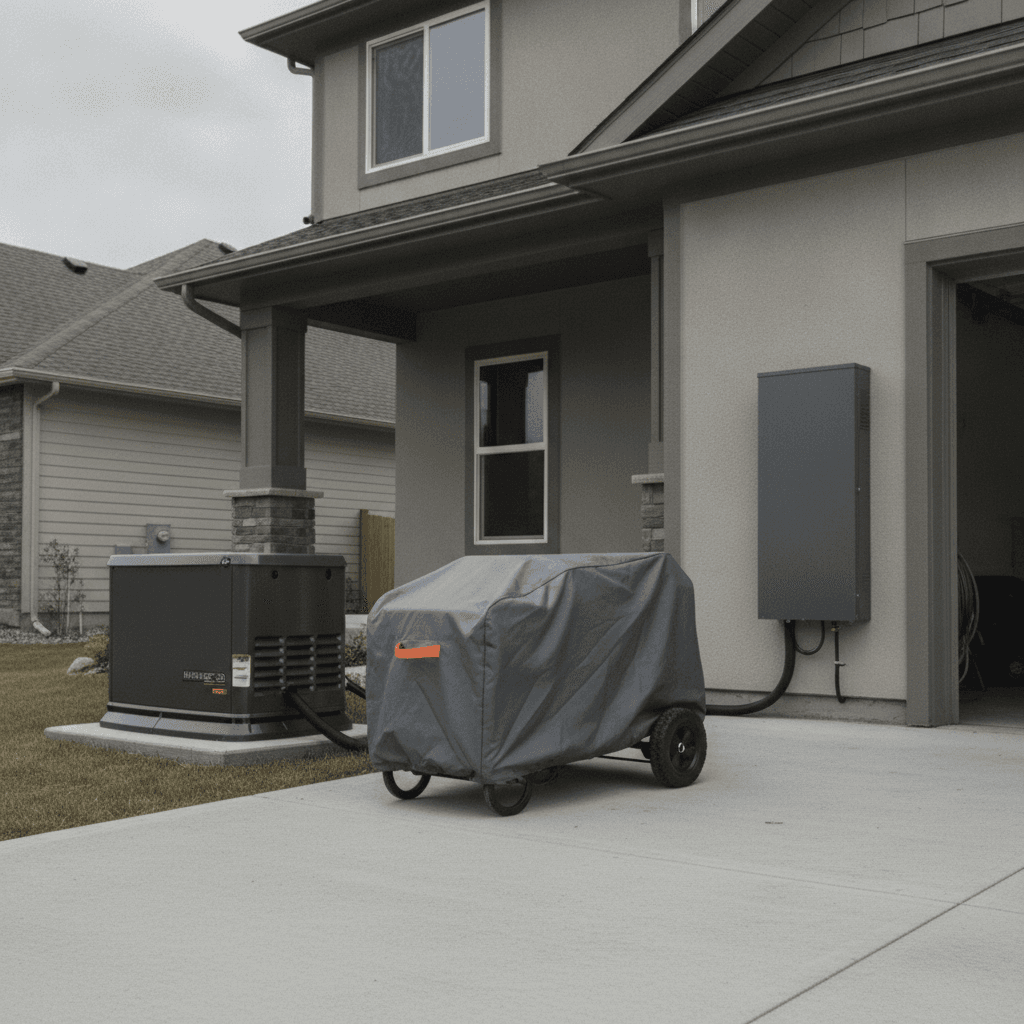
Standby vs Portable vs Home Battery: Which Fits Your Outage?
Choose by outage pattern. Portable plus interlock: $1,500-$3,500. Standby: $12,000-$18,000 installed. Home battery: $10,000-$30,000 installed.
Setup Type
Quick answer: It comes down to your outage pattern plus one or two constraints. A few short outages a year, someone usually home: a portable plus an interlock kit, $1,500 to $3,500 all-in, is the best value in backup power. Days-long outages, a well pump, medical equipment, or frequent travel: a standby at $12,000 to $18,000 installed starts itself and runs as long as the fuel lasts. Short, frequent outages plus an HOA that bans a running generator or no gas line: a home battery at $10,000 to $30,000 installed is silent and instant, though it runs down without solar.
Best for
Buyers deciding among a permanent standby, a portable with an interlock, and a home battery, keyed to how often and how long their power actually goes out, plus any HOA, noise, or gas-access constraint.
Wrong fit
Buyers who already picked their lane and want the size, the brand shortlist, or the installed quote.
Tradeoff
Portable is a fraction of the price and you run it yourself in the weather. Standby costs as much as a used car and you never touch it. A battery is silent and instant but, without solar, it is a countdown timer.
The choice comes down to your outage pattern, plus one or two constraints that can rule a lane out before price even matters. If your power blinks out a few times a year for a few hours and someone is usually home, a portable plus an interlock kit, $1,500 to $3,500 all-in, is the best value in backup power, and it is not close. If your power goes out for days at a stretch, or you have a well pump, medical equipment, or you travel and cannot be home to run a machine, a standby at $12,000 to $18,000 installed earns its keep. If your outages are short but frequent, an HOA or local rule bans a running generator, or you have no gas line, a home battery at $10,000 to $30,000 installed is the third lane: silent, instant, and indoor-safe, though it runs down in a long outage unless you pair it with solar.
Most buyers get sold the size of their fear instead of the shape of their outages. So before you price anything, answer three questions. How often does your power actually go out, for how long, and does anything, an HOA, no gas line, a noise-sensitive block, rule a lane out before cost even enters it. Those three questions pick your lane.
Quick Answer: Standby vs Portable vs Home Battery
Portable + interlock
Standby
Home battery
All-in cost
$1,500-$3,500
$12,000-$18,000 installed
$10,000-$30,000 installed
Starts itself
No, you start and connect it
Yes, automatic in seconds
Yes, instant and automatic
Runs for days
Yes, if you keep fuel on hand
Yes, on the gas line
Only if paired with solar
Fuel
Gasoline or propane you store and pour
Natural gas or a propane tank, no pouring
Electricity, plus solar if you add it
Noise
Loud, it sits in the yard
Quieter, but a weekly self-test
Silent
Indoor safe
Never, carbon monoxide
Sits outside
Yes
You have to be home
Yes
No
No
Right buyer
Outages a few times a year, hours to a couple of days
Multi-day outages, well pump, medical needs, frequent travel
Short, frequent outages, HOA rules, no gas line, or already have solar
Read down the "right buyer" row first. If you see yourself clearly in one column, you can likely stop reading there and save the comparison shopping. If two columns both sound like you, frequent short blips plus a rare multi-day storm is the common one, the honest answer is usually a combination, not a single machine, and we cover that below.
Start With Your Outage Pattern, Not the Sticker Price
Three things decide this, and none of them is on a spec sheet.
Frequency: how many times a year do you lose power. Look back over the last two or three years and count.
Duration: when it goes, is it back in an hour, or are you out for two days. A metro grid with the occasional summer blink is a different world from a rural line at the end of a wooded road, or a hurricane coast where "out" means four days.
Constraint: does an HOA or deed restriction ban a running generator, do you have no natural gas line, or is noise genuinely a problem with neighbors close by. Any one of those pushes you toward a battery even when the frequency and duration alone would point to a portable or a standby.
What the national outage data actually says
You do not have to guess at the national picture. EIA publishes it every year as SAIDI, the total minutes an average customer spends without power, split into figures that include major event days and figures that exclude them. Here is 2024, the most recent year published, converted to hours, re-checked directly against EIA's live table on 2026-09-30.
Where
Hours out, all events
Hours out, excluding major events
United States average
11.0
2.2
Texas
26.9
2.6
Florida
24.8
1.1
California
4.8
2.7
Connecticut
2.5
1.2
That table is the whole lane decision in one place. The ordinary grid, the one that runs 51 weeks a year, gives the average American household about two hours without power annually, and Florida's ordinary-year figure is actually one of the strongest in this table, better than Texas, California, or the national average. Everything above that ordinary baseline is storms. In 2024 hurricanes Beryl, Helene and Milton accounted for 80 percent of the hours Americans spent without electricity, which made it the worst year in a decade, and the difference between Texas at 26.9 hours and Connecticut at 2.5 is almost entirely which storms landed where.
Read your own state's two columns and the answer usually falls out. If the gap between the columns is small, like California or Connecticut, you are buying against short, ordinary outages and a portable covers them. If the gap is enormous, like Texas or Florida, you are buying against the storm, which is the case a standby is actually built for. That gap is also entirely storm-driven in Florida's case: EIA's own multi-year data (2019-2024) shows Florida's ordinary-year baseline holding steady at 1.1 to 1.2 hours every single year, while the all-events figure spikes to 16.9 hours in 2022 (Hurricane Ian) and 24.8 hours in 2024 (Hurricanes Helene and Milton, landing within two weeks of each other), per NOAA's National Hurricane Center tropical cyclone reports for those storms. Texas homeowners can see the full year-by-year breakdown, plus what caused each spike, in how often the power actually goes out in Texas.
One caveat before you lean on it: these are state averages across every utility, and a rural line at the end of a wooded road behaves nothing like the state mean. Your own last three years count for more than the table.
The lane it points to
A portable covers short, occasional outages beautifully and cheaply. A standby earns its price when outages are long, frequent, or happen while you are not home. Everything else is detail.
Your outage pattern
Constraint
Lane that fits
All-in
Hours, a few times a year, someone home
None
Portable plus interlock
$1,500-$3,500
Hours, frequent, noise rules or no gas line
HOA or no gas service
Home battery
$10,000-$30,000
A day or two, once or twice a year, someone home
Well pump
Portable plus interlock, sized for the pump
$1,500-$3,500
Multiple days after storms
Well pump or medical equipment
Standby
$12,000-$18,000
Multiple days, and you evacuate or travel
Nobody home to refuel
Standby
$12,000-$18,000
Frequent short blips plus rare multi-day
Both
Battery for the blips, portable for the storm
Battery plus about $2,000
The Portable Lane: $1,500 to $3,500 All-In
Here is the real all-in number, not the box price. The machine is $700 to $2,500 for a solid dual-fuel or inverter unit in the 5,000 to 7,500 watt range. The part nobody mentions is the connection. An interlock kit runs $400 to $850 installed, and it is what lets you power your home's circuits safely instead of running cords through a window or, far worse, backfeeding through a dryer outlet and putting a lineman's life at risk.
Add those together and a portable setup is $1,500 to $3,500 done right. For that you get real backup for the fridge, the heat, the well or sump pump, and the lights, on a machine you start and connect yourself in a few minutes when the power drops.
Who it is right for: homeowners with occasional outages, measured in hours to a couple of days, who are physically able to roll out a generator, and who are usually home when the lights go. That is a large share of the country.
A standby is the hands-off option. It sits on a pad outside, wired to an automatic transfer switch and fed by your natural gas line or a propane tank. When the power drops it starts itself within seconds, whether you are home or on a beach three states away, and it runs for days without anyone pouring fuel.
The price you have to plan for is the installed price, not the machine. A 22 to 24 kW standby is a few thousand dollars as a box. By the time you add the concrete pad, the gas line sizing, the transfer switch, the electrician, the plumber, and the permits, the project lands at $12,000 to $18,000. The install costs about as much as the machine, and nobody's product page tells you that. We break it down in the real cost of a whole-house generator.
Who it is right for: multi-day outages, a well pump you cannot live without, medical equipment, or a household that travels and needs backup that runs itself. If your power goes out for four days after every big storm, a standby is not a luxury, it is the tool for the job.
The trade: it is a five-figure project with permits and two trades, plus a weekly self-test that burns a little fuel and a $200 to $400 a year service habit. When those fit, you never think about power again.
The Battery Lane: $10,000 to $30,000 Installed
A home battery flips the other two lanes' logic. It stores power instead of making it, and it switches over the instant the grid drops, silently, with no fuel and no fumes. It can sit right against the house, since there is nothing to vent and no clearance rule to satisfy.
The price you plan around is the installed price, the same rule as standby: $10,000 to $30,000 depending on how many kilowatt-hours you stack and whether you add solar to refill it each sunny day.
Who it is right for: short, frequent outages, an HOA or deed restriction that bans a running generator, a home with no natural gas line, or anyone already adding solar. It is also the only lane that is fully silent and safe to run indoors.
The trade: duration. Without solar, a battery is a countdown timer, excellent for hours, not built for a four-day hurricane. We cover the full cost breakdown, the criteria table, and when the honest answer is one of each, in generator vs home battery, and our sister site homebattery.guide goes deep on sizing and solar pairing if this lane is calling you.
Three Outage Patterns, Three Answers
"Six hours, twice a year"
Suburban grid, a couple of short outages a year, usually summer storms, and someone is almost always home. This buyer does not need a standby. A 7,500 watt dual-fuel portable and a $600 interlock, about $2,000 to $2,800 all-in, keeps the fridge, the furnace, the internet, and the lights on through every outage this house has seen. Spending $15,000 to automate six hours a year is buying convenience you will use twice. Put the difference somewhere it matters more.
"One week-long hurricane outage"
Gulf coast, a well pump, and when a hurricane hits, the power is gone for four to seven days and the family sometimes evacuates. This is the standby buyer. A portable can bridge a day or two if someone is home to refuel it, but nobody wants to be pouring gasoline every few hours for a week, and it does nothing if the house is empty. A standby at $12,000 to $18,000 installed, running on the gas line or a big propane tank, is sized exactly for this pattern. Pair it with hurricane season prep and it is the last time that outage is a crisis.
"Frequent short blips, and an HOA that bans a generator"
A townhouse or an HOA community with strict noise and equipment rules, grid blips a few times a month lasting minutes to an hour, and no permission to run a generator in the yard even if the buyer wanted one. This is the battery buyer. A right-sized home battery switches over silently before anyone in the house notices, with no rule to break and no fuel to store. If the rare multi-day outage still worries you, the honest fallback is a battery paired with solar, or a small portable kept ready for the one storm a decade that outlasts the battery. Read generator vs home battery for the sizing and solar side of this decision.
Frequently Asked Questions
Standby generator, portable with an interlock, or a home battery: which one fits my outage pattern?
Match the pattern first, then check for a constraint that overrides it. A few short outages a year with someone usually home: portable plus interlock, $1,500 to $3,500 all-in. Multi-day outages, a well pump, medical equipment, or frequent travel: standby, $12,000 to $18,000 installed. Short but frequent outages, an HOA that bans a running generator, or no gas line: home battery, $10,000 to $30,000 installed. Many storm-belt homes end up combining a battery for the frequent blips with a portable or standby for the rare multi-day event.
Is a standby generator worth it over a portable?
It depends entirely on your outage pattern. If you lose power for days at a time, have a well pump or medical equipment, or travel and cannot run a machine yourself, a standby at $12,000 to $18,000 installed is worth it. If your outages are a few short ones a year and you are usually home, a $1,500 to $3,500 portable does the same job for a fraction of the money.
How much does a whole-house standby generator cost installed?
Plan on $12,000 to $18,000 installed for a 22 to 26 kW system. The machine itself is a few thousand dollars. The rest is the concrete pad, gas line, automatic transfer switch, electrician, plumber, and permits. The install costs about as much as the machine, which is why the sticker price on the box is misleading.
Can a portable generator power my whole house?
It can power the essentials of most homes, the fridge, heat, well or sump pump, and lights, through an interlock kit wired to your panel. It will not run central air plus everything at once. A 5,000 to 7,500 watt portable connected legally covers what matters in an outage for the large majority of homes.
How often do I have to refuel a portable generator during an outage?
Roughly every 8 to 12 hours at a moderate load, depending on the tank and how much you are running. Champion publishes 10 hours at 50 percent load on the 7.7-gallon tank of its 7500-watt dual-fuel unit, and 5.5 hours on a 20-pound propane cylinder, which is about the middle of that band. This is the real limit of the portable lane. For a multi-day outage someone has to be home to keep it fed, which is exactly where a standby pulls ahead.
Do I need an electrician for a portable generator?
For a safe, legal connection, yes, once. An interlock kit or manual transfer switch has to be installed at your panel by an electrician, usually $400 to $850 for an interlock. After that you connect the generator yourself with one cord and a flip of the interlock. What you must never do is backfeed through a dryer or range outlet, which can kill a utility lineman.
What is an interlock kit and do I need one?
An interlock kit is a metal plate on your electrical panel that lets you safely power your home's circuits from a portable, while making it physically impossible to backfeed the grid. If you want a portable to run your house wiring instead of extension cords, then yes, you need an interlock or a transfer switch. The full comparison is in interlock kit vs transfer switch.
Should I get a battery instead of a generator?
For short, silent, indoor-safe backup, especially with solar or an HOA that bans generators, a home battery can be the better call. For multi-day outages it runs down, so a generator wins on duration. Many homes end up with a battery for daily blips and a portable for the rare long outage. See generator vs home battery.
What we could not verify
Installed prices. The $1,500 to $3,500 portable band, the $400 to $850 interlock, the $12,000 to $18,000 standby project, and the $10,000 to $30,000 home battery band are this site's own figures, built from the six state cost pages and manufacturer catalogues. The national cost aggregators that publish averages block automated retrieval, so no third-party average is quoted here.
Your own outage history. EIA's state figures are utility-weighted averages. They do not describe a specific address, and a rural feeder behaves nothing like a state mean.
These guides are built from manufacturer documentation, public specifications, primary research where health claims matter, and repeated buyer questions that show up in real ownership and installation decisions.
Manufacturer responses can clarify pricing bands, warranty terms, support footprint, or common mistakes. They do not move a page up the shortlist on their own.