Generator Maintenance Cost: What Owners Actually Pay
Standby service runs $200 to $400 a year plus oil and a battery every 2 to 3 years. Portable owners pay in stale fuel and no-starts.
Budget
Quick answer: A standby generator costs $200 to $400 a year for a service contract, plus an oil and filter change and a new starting battery every two to three years. A portable costs less in dollars and more in discipline: gasoline goes stale in one to three months without stabilizer, and gummed carburetors are the number one reason a generator will not start when the storm hits. Propane does not go stale, which is the quiet advantage of a dual-fuel portable. Budget the upkeep before you buy, because the year-three no-start is a pattern, not bad luck.
Best for
Owners and about-to-be owners who want the running cost and the upkeep routine before they sign or store fuel.
Wrong fit
Buyers still choosing between standby and portable, start with the cost and sizing guides first.
Tradeoff
Standby upkeep costs money on a schedule. Portable upkeep costs attention, and skipping it shows up as a no-start on the worst possible day.
A standby generator costs $200 to $400 a year for a service contract, plus an oil and filter change and a new starting battery every two to three years. A portable costs almost nothing in scheduled dollars, and everything in discipline: gasoline goes stale in one to three months without stabilizer, and a gummed-up carburetor is the number one reason a generator will not start when you finally need it.
That gap is the whole story. Standby upkeep is a line item you pay on a calendar. Portable upkeep is a habit you keep, or don't. We don't sell generators. We save you from buying the wrong one, and plenty of people buy the right machine and then let it die in the garage. This guide prices both kinds of upkeep so nothing catches you at 2 a.m. during an outage.
Standby costs more in dollars and almost nothing in attention. Portable costs almost nothing in dollars and a lot in attention. Neither is free, and the one that fails is almost always the one whose upkeep got skipped.
What Standby Maintenance Actually Costs
A standby asks for money on a schedule and very little of your time. That is what you are buying.
The annual service contract, $200 to $400
Most owners buy an annual plan from the dealer or a local shop for $200 to $400 a year. A visit covers the oil and filter change, an air and spark check, a battery test, and a look at the transfer switch and connections. You can do the basics yourself, but for a lot of standby owners the contract is the entire reason they went standby: they wanted it handled. If that is you, the contract is not overhead, it is the product.
Oil, filter, and the every-two-year rule
Do not guess at this one, because the manufacturer publishes it. Generac's owner's manual for its 9kW to 22kW air-cooled units sets out a two-tier schedule:
Service
Interval
Check oil level, enclosure louvers, fuel and oil leaks
Daily if running continuously, or before each use
Check for water intrusion, check battery condition and state of charge
Every year
Replace engine oil and oil filter (Schedule A)
Every two years or 200 hours
Replace air filter, clean and gap or replace spark plugs, inspect and adjust valve clearance (Schedule B)
Every four years or 400 hours
Two footnotes on that schedule matter more than the table. The first oil and filter change comes after the first 25 hours of operation, and the valve clearance gets checked at the same 25-hour mark. And the interval halves in hard conditions: below 40F ambient, or running continuously above 85F, Generac calls for oil and filter every year or 100 hours instead.
Because a generator that mostly runs weekly self-tests does not clock many hours, the calendar rule is usually what triggers it. Note also that the air filter and spark plugs are a four-year item on Generac's schedule, not an annual one, so an annual visit that bills for both every year is doing more than the manual asks. Oil, filter, and a plug are cheap. Forgetting them for five years shortens the engine's life, and Generac states directly that to maintain the product warranty the engine oil must be serviced according to the manual.
The starting battery, every two to three years
This is the standby failure that catches the most people. The battery that cranks the engine wears out on its own timeline, and a weak one will not start the generator when the grid drops, no matter how healthy the engine is.
Be clear about what is manufacturer specification and what is practice here. Generac specifies checking battery condition, electrolyte level and state of charge every year and again at each scheduled service, and its current air-cooled units call for a 12-volt AGM Powersport battery, Group BTX30L, 400 cold cranking amps minimum. Generac does not publish a replacement interval. The two-to-three-year rule is a practical one from how these batteries actually age in an outdoor enclosure, not a number from the manual, and we would rather say so than dress it up as a spec.
Either way, replace it proactively rather than waiting for a no-start. A battery is a small cost against the whole install, and it is the single most common reason a standby sits silent during an outage.
The weekly self-test, fuel and noise
A standby runs a self-test on a schedule. Generac's current air-cooled units run it for an adjustable 5 to 20 minutes with 5 minutes set at the factory, at a reduced engine speed in Quiet-Test mode, published at 55 dB(A) at 23 feet against 67 at normal load. It exercises the engine and keeps things ready, which is good.
Nobody publishes what that test costs to run, so here is the arithmetic with its assumption stated. Five minutes a week is 4.33 hours a year. No manufacturer publishes a no-load burn rate, so use the half-load figure from Generac's own spec sheet as a deliberate upper bound: 221 cubic feet an hour on natural gas, or 2.45 gallons an hour on propane. That is at most 957 cubic feet of gas a year, about $18 at EIA's 12-month average residential price of $19.28 per thousand cubic feet, or at most 10.6 gallons of propane, about $28 at EIA's last published residential price of $2.674 a gallon.
So the weekly self-test costs under $20 a year on natural gas and under $30 on propane, and the real figure is lower than both because the test runs at low speed with no load. It is a rounding error next to the service contract. What it is not a rounding error against is a small propane tank: 10.6 gallons a year is real reserve, and it is worth knowing before an outage rather than during one.
What Portable Maintenance Actually Costs
A portable barely touches your wallet on a schedule. It asks for attention instead, and the attention is what keeps it alive.
Stale gas is the number one no-start
Gasoline does not keep, and the engine manufacturers say so plainly. Briggs & Stratton's own guidance is that gas "begins to degrade in as little as 30 days," which can clog the fuel system and leave the equipment unable to start the following season. That gummy residue blocks the tiny passages in the carburetor, and the result is the story from every owner group: the storm comes, you pull the cord, and nothing.
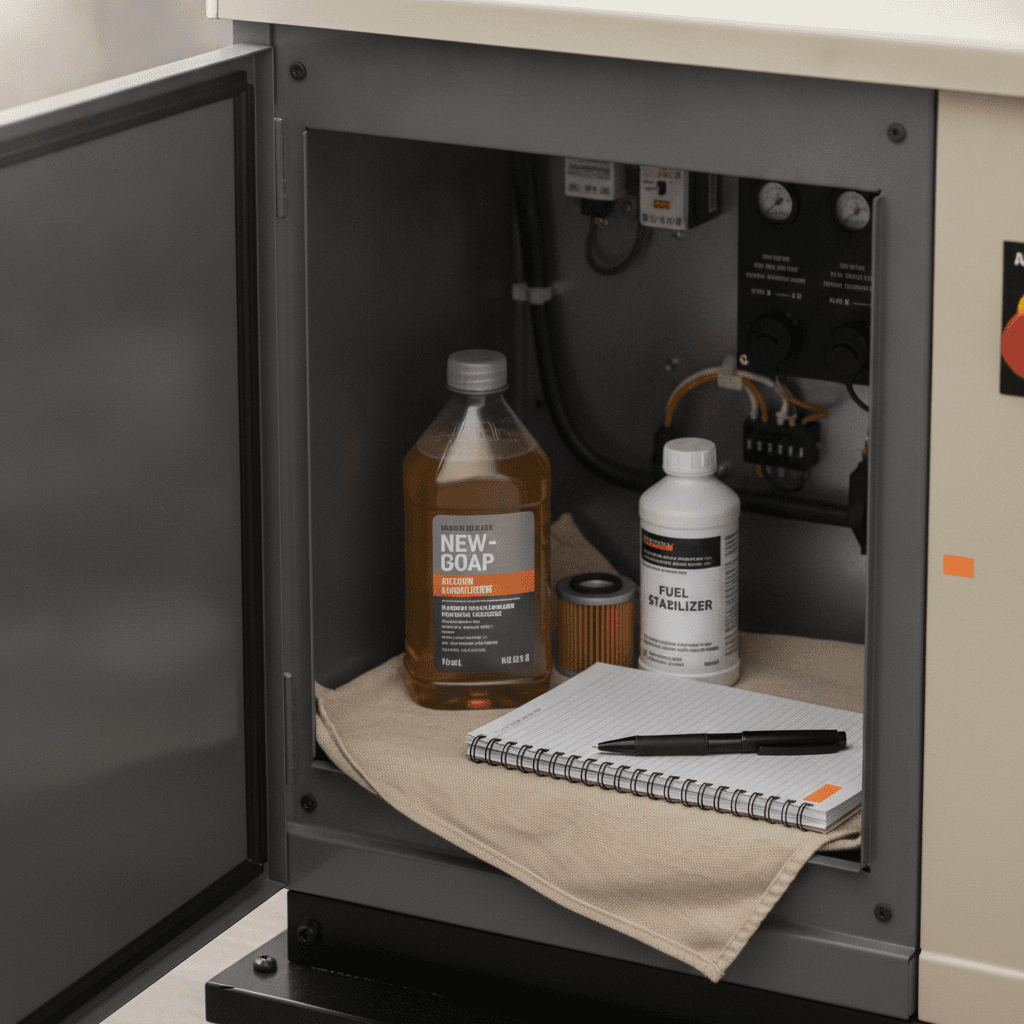
The fix is cheap and boring. Add a fuel stabilizer, which keeps treated gas usable for roughly 12 months, and run the tank dry or drain the carburetor before long storage. Stabilizer makers claim longer, up to 24 months and in Briggs' case up to three years, but those are product claims rather than independent test data, so plan on a year.
Two rules from Honda's generator-specific fuel guidance are worth taking literally. Fuel stabilizers will not reconstitute stale fuel, so adding stabilizer to gas that has already gone off does nothing. And past one year of storage, drain the tank and carburetor even if the fuel was treated, because treated gasoline still deteriorates in long-term storage. Honda's threshold for adding stabilizer at all is storage beyond four weeks. Do that and a portable is reliable for years. Skip it and you are cleaning a carburetor in the dark.
The monthly 20-minute test run under load
A portable wants a monthly run, about 20 minutes, ideally under a real load like a couple of space heaters or a fridge, not just idling. Running it keeps the carburetor wet with fresh fuel, charges any electric-start battery, and tells you it works before you are betting the freezer on it. Do this outside, far from windows and doors, every time. It costs a little fuel and twenty minutes, and it is the cheapest insurance in this guide.
Propane does not go stale, the dual-fuel advantage
Here is the quiet reason so many buyers land on a dual-fuel portable: propane stores essentially forever. It does not varnish carburetors, it does not need a stabilizer, and a couple of 20-pound tanks in the garage are ready in a year or in five. Run the machine on propane for storage and reliability, keep gasoline as the higher-output option, and you sidestep the number one no-start cause entirely. If low-maintenance reliability is what you want, dual-fuel is the pick, and the fuel tradeoffs are in natural gas vs propane. For specific units, see the best portable generators for home backup.
What Voids the Warranty
A few upkeep sins will cost you a claim, so know them going in. Running stale or wrong fuel and then blaming the engine is a common denial. So is skipping documented service intervals on a standby, since dealers can ask for your records. Modifying the unit, running it badly overloaded, or letting an unlicensed person do the standby install and wiring can all void coverage too. None of this is exotic. Keep receipts, follow the schedule in your manual, and use the right fuel and oil, and you keep your warranty. The buying regrets guide collects the ones owners wish they had known.
The Year-Three No-Start Pattern
Owner groups tell the same story on a loop, and it clusters around year three. Someone buys a generator, runs it a few times the first season, then life gets busy. No stabilizer goes in the gas. The standby's battery is never replaced. Two or three years later a storm arrives, and the machine that cost thousands will not start, because upkeep got skipped, not because the machine failed.
The lesson is not that generators are unreliable. It is that a generator is only as ready as its last bit of maintenance. For a standby, put the battery on a two to three year calendar reminder and keep the service contract current. For a portable, stabilize the fuel or store it dry, and run it 20 minutes a month. Ten minutes of habit beats a dead machine during the one week a year you need it. Keep every safety rule intact while you test, starting with never run a generator indoors, which is served straight and sells nothing.
Want these annual figures summed into a single decade-long number, plus what a controller board or transfer switch repair actually costs when one happens? See what a standby generator costs to own for 10 years.
How much does it cost to maintain a standby generator per year?
Budget $200 to $400 a year for a dealer or local service contract, which covers the oil and filter change, a battery test, and a general inspection. On top of that, plan for a new starting battery every two to three years. If you do the basic oil changes yourself, your out-of-pocket drops to the price of oil and filters, but many owners keep the contract precisely because they wanted the whole thing handled.
How often do you change the oil in a standby generator?
Generac's owner's manual for its air-cooled units calls for the first oil and filter change after the first 25 hours of operation, then every two years or 200 hours after that, whichever comes first. In cold conditions below 40F, or continuous running above 85F, that shortens to every year or 100 hours. Because weekly self-tests do not add many hours, the calendar rule is usually what triggers it. Check your own model's manual, since intervals vary by brand.
Why won't my generator start after sitting for a year?
Almost always stale fuel. Briggs & Stratton states that gasoline begins to degrade in as little as 30 days, and the residue clogs the tiny passages the carburetor needs. That is the number one no-start cause on portables. Add a fuel stabilizer for storage, or store the machine with the fuel drained, and run it 20 minutes a month. If the fuel has already gone stale, stabilizer will not rescue it: Honda's guidance is explicit that stabilizers will not reconstitute stale fuel, and that anything stored more than a year should be drained regardless.
Does propane go stale like gasoline?
No. Propane stores essentially forever without degrading, does not gum up carburetors, and needs no stabilizer. That is the main upkeep reason buyers choose a dual-fuel portable: run it on propane for storage, keep gasoline for higher output, and you avoid the stale-fuel no-start entirely. See the best portable generators for home backup for dual-fuel picks.
How often should I run my portable generator?
About once a month for 20 minutes, ideally under a real load rather than idling. Running it keeps fresh fuel in the carburetor, charges any electric-start battery, and confirms it works before you depend on it. Always run it outside, far from windows, doors, and vents. It is the cheapest and most useful maintenance habit you can keep.
What maintenance mistakes void a generator warranty?
The common ones are running stale or wrong fuel and then claiming engine damage, skipping documented service intervals on a standby, overloading the unit, modifying it, and letting an unlicensed person do the standby install and wiring. Keep receipts, follow the manual's schedule, and use the specified oil and fuel, and you keep your coverage.
Is a maintenance contract worth it for a home standby generator?
For many owners, yes. At $200 to $400 a year it covers the oil, filter, battery test, and inspection, and it keeps your service records in order, which matters for warranty claims. If you are handy and will actually track the intervals yourself, you can skip it and just buy oil, filters, and a battery on schedule. If you bought standby because you wanted it handled, the contract is the point.
What we could not verify
The $200 to $400 a year service contract. No manufacturer, dealer association or public agency publishes a national price for a residential standby service plan. This is the site's own band from dealer quotes, and it is the one figure on this page with no primary source behind it. Ask two dealers what their plan covers and what it costs, in writing.
Battery replacement interval. Generac specifies annual condition checks and the battery group and cold cranking amps, but publishes no replacement interval. Two to three years is practice, not specification.
Repair costs by failure mode. Controller board, transfer switch contactor and block heater replacement costs are not published by any manufacturer, and we do not have enough of our own invoice data to publish patterns. When we do, they will appear here with a date and a sample size.
No-load exercise burn rate. No manufacturer publishes one, which is why the self-test fuel figure above is calculated at the half-load rate as an explicit upper bound rather than as an actual measurement.
These guides are built from manufacturer documentation, public specifications, primary research where health claims matter, and repeated buyer questions that show up in real ownership and installation decisions.
Manufacturer responses can clarify pricing bands, warranty terms, support footprint, or common mistakes. They do not move a page up the shortlist on their own.