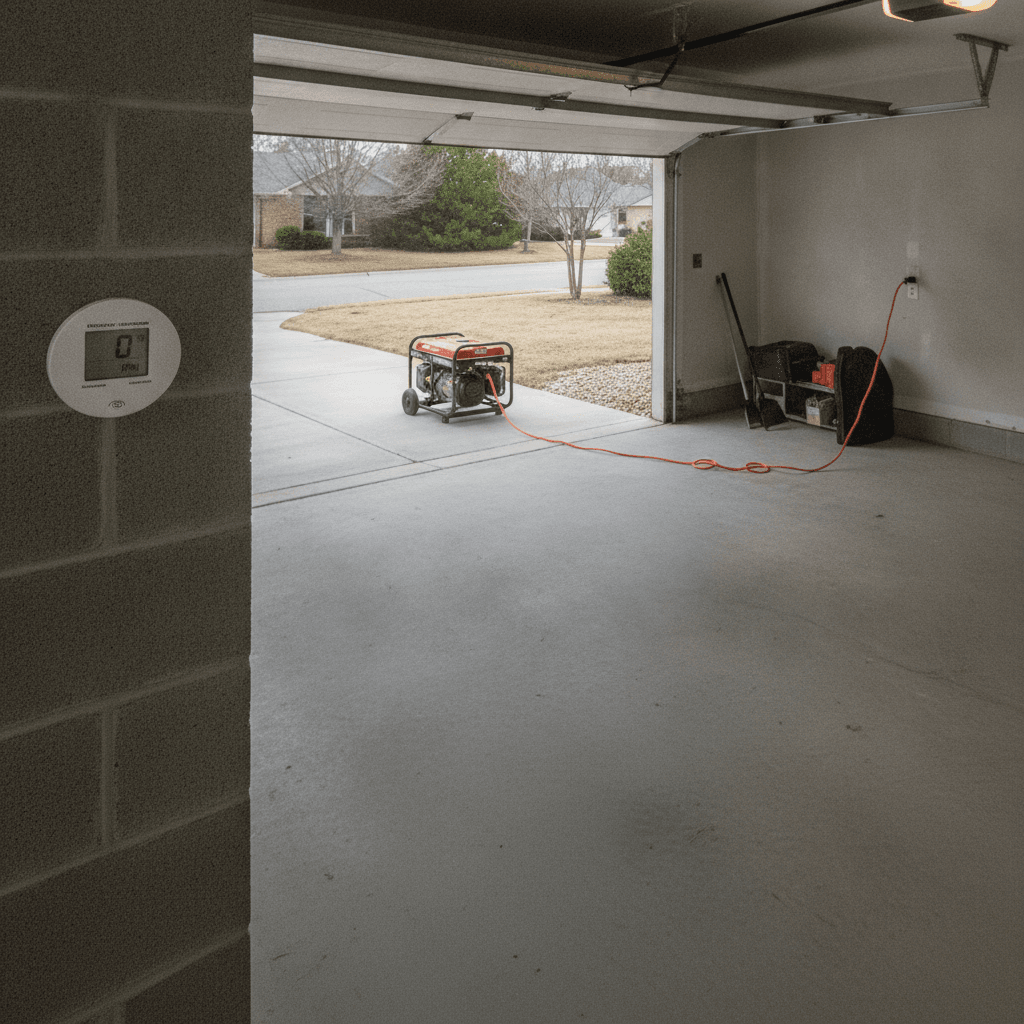
Never Run a Generator Indoors: CO Kills in Minutes
Never run a generator indoors, in a garage, on a porch, or near a window. CO is odorless and kills in minutes. The rules that keep you safe.
Installation
Quick answer: Never run a portable generator indoors. Not in the house, not in the garage with the door open, not in the basement, not on a porch, and not next to a window. The exhaust is carbon monoxide, a gas you cannot see or smell that can kill in minutes, and opening a door does not make it safe. Run it outside only, at least 20 feet from the house, with the exhaust pointed away, and keep battery-operated CO alarms on every level.
Best for
Anyone deciding where to put a running generator, especially during a storm outage.
Wrong fit
Nobody. Everyone who runs a generator needs this. It is short on purpose.
Tradeoff
There is no tradeoff to make here. Indoors is never safe, no matter the weather or how briefly you plan to run it. The only safe place is outside, well away from the house.
Never run a portable generator indoors. Not in the house, not in the garage with the door open, not in the basement, not on a porch, and not right next to a window. The exhaust is carbon monoxide, a gas you cannot see or smell, and it can kill in minutes. Opening a door or a window does not make it safe.
The only safe place to run a portable generator is outside, at least 20 feet from the house, with the exhaust pointed away from every door, window, and vent. This page exists to say that plainly, because every storm season the same preventable deaths happen, and almost all of them start with a generator run somewhere it should never have been.
Quick Answer: The Rule and Why the Exceptions Are Fatal
"But what about..."
Answer
The garage, with the door open
No
The basement
No
A porch or carport
No
Right outside an open window
No
A shed or enclosed patio
No
Just for a few minutes
No
Outside, 20+ feet away, exhaust pointed away from the house
Yes
Per CPSC, never use a portable generator inside a home, garage, basement, crawlspace, or shed, or on a porch, even if the doors and windows are open. There is no version of indoors that is safe, and there is no run short enough to be safe indoors.
Why an Open Door Does Not Save You
The open-door idea is the one that kills people, so here is why it fails. CPSC staff put the scale plainly in the agency's 2022 rulemaking: "The CO emission rates of portable generators are on the order of hundreds of times the CO emission rates of gasoline powered automobiles." An open garage door or a cracked window does not move air fast enough to clear that. The gas builds up faster than the opening lets it out, and it keeps building the whole time the engine runs. CPSC's own safety sheet says it in four words: never use inside a home or garage, "EVEN IF doors and windows are open."
You get no warning, because carbon monoxide is colorless and odorless. There is no smell to notice, no smoke to see. The first signs are in your body, not the air: headache, dizziness, weakness, nausea, sleepiness, confusion (CPSC). Those feel like the flu or like being worn out after a storm, so people lie down. At high concentrations, victims lose consciousness before they understand what is happening, and they do not wake up. That is why "I felt fine for a while" is not evidence that a space is safe.
Why the Deaths Come After the Storm
Portable generators are one of the leading causes of carbon monoxide deaths after storms, and the pattern repeats every season. The power goes out after a hurricane or an ice storm, people run generators to keep the food cold and the house warm, and the machine ends up in the garage to keep it out of the rain, or on the porch, or under a bedroom window, often running overnight while everyone sleeps.
CPSC's published figure is that more than 80 consumers die each year from CO poisoning caused by portable generators. Its own data puts numbers behind that. The rulemaking record counts at least 1,332 CO deaths involving portable generators from 2004 through 2021. CPSC's most recent statistical estimates, published in May 2026, put generators at an estimated 98 non-fire CO deaths a year averaged across 2020 through 2022, or 41 percent of every consumer-product CO death in the country. The circumstances are almost always the same, and almost always preventable. If you are getting ready for a storm, set up the safe location before you need it, not in the dark during the outage. Our hurricane season generator prep guide covers the timing and the checklist.
The Rule That Keeps a Family Alive
Outside only. At least 20 feet from the house. Exhaust directed away from the home and other buildings, and never near an opening to your home, including doors, windows and vents. That is CPSC's rule word for word, it is the whole rule, and it does not bend for rain, cold, noise, or worry about theft.
If weather is the reason you want to bring it closer, use a cover or canopy made for generators that keeps the machine dry while leaving the exhaust in open air. If noise or theft is the reason, the answer is distance and a cable lock, not the garage. For the complete setup, including refueling and wet-weather handling, see the generator safety guide.
Carbon Monoxide Alarms Are Not Optional
You cannot smell carbon monoxide, so you need something that can. CPSC recommends battery-operated CO alarms, or alarms with battery backup, on every level of the home and outside sleeping areas, tested monthly. Battery power is the point, because the generator runs when the grid is down. An alarm is the difference between waking up to a beep and not waking up at all.
Generators That Shut Themselves Off
Some newer portable generators include a carbon monoxide sensor that shuts the engine off automatically when the gas builds up around the unit. CPSC tells buyers to ask retailers for it, and it is a real improvement. The feature is built to one of two voluntary industry standards, ANSI/PGMA G300-2023 (Safety and Performance of Portable Generators) or UL 2201-2023 (Carbon Monoxide Emission Rate of Portable Generators). Neither is a federal requirement. CPSC modelled both and found the UL 2201 version stronger, because it caps the engine's CO output as well as shutting the unit down, but it also concluded that neither standard is adequate on its own and has proposed a mandatory rule that borrows from both.
It is a backup, not permission. CPSC's own fatality report records a three-person death involving a generator advertised as certified to ANSI/PGMA G300-2018. A shutoff sensor is there to catch a mistake, not to make running a generator in the garage acceptable. The rule does not change: outside only.
If Someone Has Symptoms
If anyone develops a headache, dizziness, nausea, weakness, sleepiness, or confusion while a generator is running, or if a CO alarm sounds, act immediately. Get everyone, including pets, outside into fresh air. Then call 911. Do not stop to find the source or open more windows first. Fresh air, then the call.
If someone has collapsed or will not wake, get them out into fresh air if you can do it safely, and call 911 right away. Do not go back into the space until the generator is off and the area has fully cleared, and do not wave off an alarm because everyone "feels okay." Carbon monoxide can drop a person fast.
What to Do Instead
Running a generator the safe way is not complicated. Put it outside, well away from the house, and connect it properly. The legal way to power your home from a portable generator is through an interlock kit or a transfer switch installed by a licensed electrician, not an extension cord through a cracked window, and never by backfeeding an outlet. If that part is new to you, interlock kit vs transfer switch explains the options and the real costs.
Frequently Asked Questions
Can I run a generator in the garage with the door open?
No. CPSC is explicit that you should never run a portable generator in a garage, even with the door open. An open door does not clear carbon monoxide fast enough, and because the gas is odorless you get no warning as it builds. Run the generator outside, at least 20 feet from the house.
Is it safe to run a generator on the porch or under a carport?
No. A porch and a carport are both too close to the house, and CPSC names both as places not to run a generator. The exhaust can reach doors, windows, and vents and enter the living space. The generator belongs in the open, at least 20 feet away, with the exhaust pointed away from the house.
How far from the house does a generator need to be?
At least 20 feet, per CPSC, with the exhaust aimed away from the house and away from any door, window, or vent. Treat that as a floor, not a goal. More distance is safer, and exhaust direction matters as much as the number of feet.
Can carbon monoxide from a generator come in through a window?
Yes. That is one of the most common ways it happens. A generator running just outside an open or leaky window, or with its exhaust pointed toward the house, can push carbon monoxide straight indoors. Keep the unit at least 20 feet away, point the exhaust away, and close and seal windows and vents near it.
What are the first signs of carbon monoxide poisoning?
Headache, dizziness, weakness, nausea, vomiting, sleepiness, and confusion (CPSC). They are easy to mistake for the flu or for ordinary tiredness. If anyone feels this way while a generator is running, get outside to fresh air immediately and call 911.
What should I do if my CO alarm goes off while the generator is running?
Treat it as real. Get everyone outside into fresh air, then call 911 (CPSC). Do not ignore the alarm, do not wait to see if you feel sick, and do not go back inside until the generator is off and the space has cleared.
Is it okay to run a generator indoors for just a few minutes?
No. There is no safe amount of time to run a generator indoors. CPSC's own headline is that using a generator indoors can kill you in minutes, and its rulemaking puts a portable generator's CO output at hundreds of times a car's. A short run in a garage, basement, or enclosed porch is still dangerous. Outside only, every time.
These guides are built from manufacturer documentation, public specifications, primary research where health claims matter, and repeated buyer questions that show up in real ownership and installation decisions.
Manufacturer responses can clarify pricing bands, warranty terms, support footprint, or common mistakes. They do not move a page up the shortlist on their own.