Interlock kit ($400 to $850) vs manual transfer switch (up to $1,500). What each does, code and permits, and why it is all electrician work.
Installation
Quick answer: To power your house from a portable generator legally, you need an interlock kit or a transfer switch, wired in by a licensed electrician. An interlock kit runs about $400 to $850 installed and lets you feed the whole panel while you manage the load by hand. A manual transfer switch runs up to about $1,500 and powers a fixed set of circuits with less juggling. Both prevent backfeeding, which is illegal and can kill utility workers. The automatic transfer switch that swaps power for you belongs to the standby lane and runs $2,000 to $5,000 in electrical work.
Best for
Portable generator buyers pricing the legal connection to the house, and anyone reading an electrician's quote.
Wrong fit
Buyers set on a whole-house standby, where the automatic transfer switch is part of the install cost, not a separate choice.
Tradeoff
The interlock kit is cheaper and feeds the whole panel but makes you manage the load by hand. The transfer switch costs more and powers fewer circuits, but it is simpler to run during an outage.
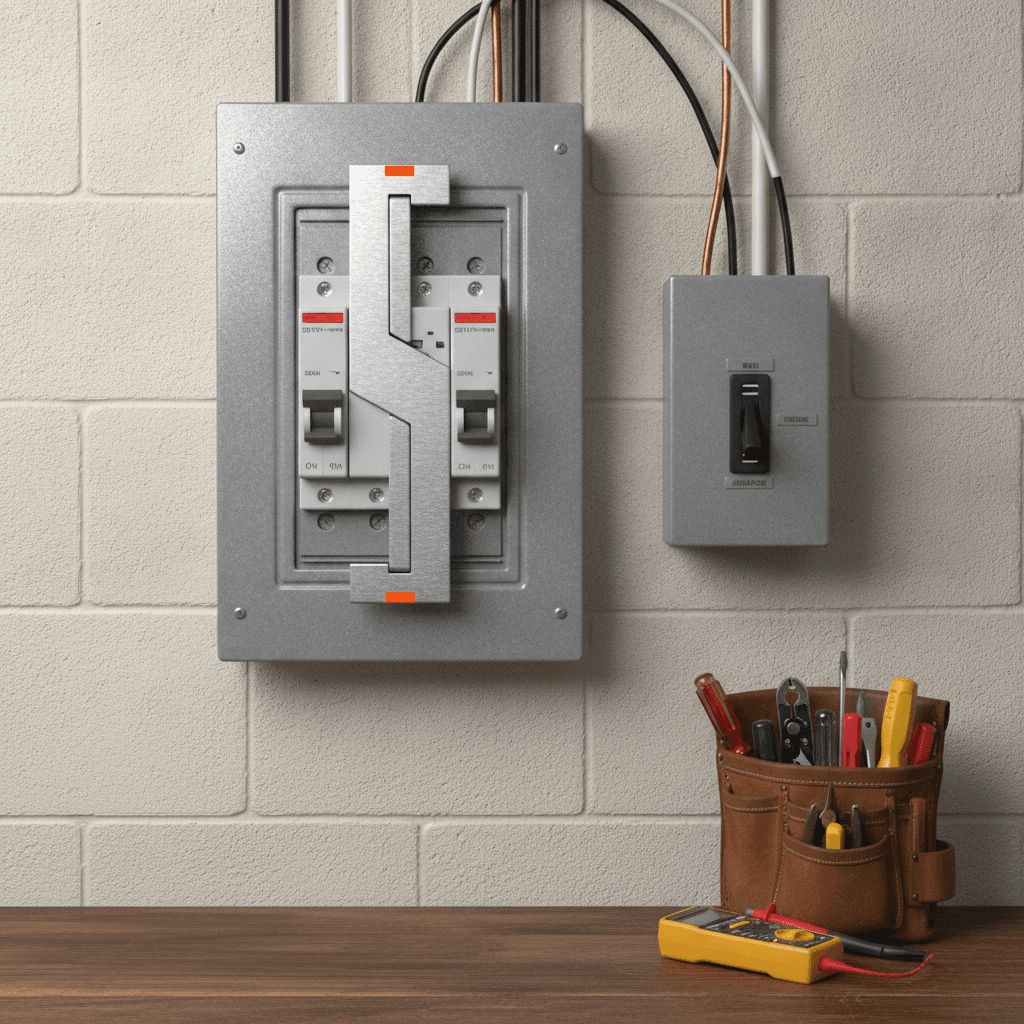
To power your house from a portable generator safely and legally, you need one of two things wired into your panel by a licensed electrician: an interlock kit or a transfer switch. An interlock kit runs about $400 to $850 installed. A manual transfer switch runs up to about $1,500. Both do the same core job: they make it impossible for your generator and the grid to feed the panel at the same time, which keeps utility workers and your own wiring safe.
This is the portable lane's hidden cost. The generator is the sticker price you see. The legal connection is the part the box never mentions, and it is the difference between a safe setup and an extension cord through a window. Here is what each option is, what it costs, and how to read the quote.
Quick Answer: Interlock vs Transfer Switch at a Glance
Interlock kit
Manual transfer switch
Automatic transfer switch
Typical installed cost
$400-$850
Up to ~$1,500
$2,000-$5,000
What it does
Blocks the main and generator breakers from being on at once
Powers a fixed set of chosen circuits
Switches the house to the generator on its own
Which circuits
Whole panel, you manage the load
Only the circuits it is wired to
Whole house or selected
Work during an outage
You flip breakers by hand
You flip a few switches
None
Lane
Portable
Portable
Standby
Installed by
Licensed electrician, permitted
Licensed electrician, permitted
Licensed electrician, permitted
What an Interlock Kit Is
An interlock kit is a simple mechanical part: a sliding metal plate that mounts on your electrical panel. It sits over the main breaker and a dedicated generator breaker, shaped so that only one can be switched on at a time. When the main is on, the plate covers the generator breaker. To use the generator, you slide the plate, turn the main off, and turn the generator breaker on. The grid and the generator can never both feed the panel, which is the entire point.
It is the cheapest legal way to connect a portable generator to your house, usually $400 to $850 installed. You plug the generator into an exterior inlet the electrician adds, start it outside, then switch over at the panel. Because it feeds the whole panel, you manage the load yourself, turning off the big draws such as the range, dryer, and water heater so you stay under the generator's rating. Our what size generator do I need guide covers that.
Code and Permit Reality
The code requirement behind all of this is short. NEC Article 702 covers optional standby systems, and 702.5 says transfer equipment "shall be suitable for the intended use and designed and installed so as to prevent the inadvertent interconnection of normal and alternate sources of supply in any operation of the transfer equipment." That wording is stable across editions; the 2023 edition retitled the section to Interconnection or Transfer Equipment.
Notice what that does and does not say. It does not name interlock kits anywhere. A panel interlock is legal because it is transfer equipment that satisfies 702.5, not because a separate interlock rule exists. So anyone telling you "the NEC requires a listed interlock" is paraphrasing. What the code requires is transfer equipment suitable for the intended use that makes simultaneous connection impossible.
Where "listed" bites is elsewhere in the code. NEC 110.2 says equipment is acceptable only if approved, and 110.3(B) says listed or labeled equipment must be installed in accordance with its listing instructions. A shop-made plate has no listing and no manufacturer instructions, so there is nothing to show an inspector that it is suitable. Authorities having jurisdiction say the same thing in plainer language. Volusia County, Florida's residential generator handout requires "an interlock device suitable for the intended use," installed "to prevent the inadvertent interconnection of the normal and the optional system supply," and states flatly that "the back-feeding of electrical outlets within the home is not permitted."
There is one more requirement worth knowing about, because a lot of quotes miss it. NEC 702.7(C) requires a warning sign near a power inlet used for a temporary portable-generator connection, stating whether the system is wired for a separately derived (bonded neutral) or nonseparately derived (floating neutral) generator. If your inlet has no such label, the job is not finished.
Two practical things before you assume an interlock is the answer. A homemade or mismatched interlock can fail inspection and get red-tagged. And some panels have no listed kit available at all, which pushes you toward a transfer switch instead. A good electrician will tell you which situation you are in.
What a Manual Transfer Switch Is
A manual transfer switch is a small sub-panel the electrician wires to a fixed set of circuits you choose in advance, typically the furnace, the refrigerator, a well pump, and a few outlets and lights. During an outage you start the generator outside, plug it in, and flip that set of circuits over to generator power with labeled switches.
The cost runs up to about $1,500 installed, more than an interlock. What you get for the extra money is simplicity and a lower chance of overload. You are not touching the main breaker or juggling the whole panel, and each essential circuit has its own labeled switch, sized so you are less likely to ask for more than the generator can give. For people who do not want to think about load math during a storm, that is worth something. The tradeoff is that it only powers the circuits it is wired to, and adding one later is another visit and more electrician time.
What an Automatic Transfer Switch Is
An automatic transfer switch (ATS) is the standby lane's device, not a portable accessory. It is permanently wired between the utility and a fixed standby generator. When it senses the power drop, it starts the standby unit and transfers the house over on its own, then switches back when the grid returns. You do nothing.
That convenience is not cheap, and it does not stand alone. Budget $2,000 to $5,000 for the transfer switch and electrical work as part of a standby installation, a much larger project overall. If you are weighing that path, see the real cost of a whole-house generator and standby vs portable generator, because for standby the install costs as much as the machine.
Why Backfeeding Is Illegal and Deadly
There is a fourth "option" people ask about, and the answer is never. Backfeeding means powering your house by plugging the generator into an ordinary outlet, usually a dryer or range outlet, with a double-ended cord and no switch in between. It is illegal, and it kills.
Here is the mechanism, in OSHA's words. Attaching a generator directly to a building's electrical system without a properly installed transfer switch "can energize wiring systems for great distances," which "creates a risk of electrocution for utility workers and others in the area." A lineman working to restore your power expects a dead wire and instead meets a live one. ESFI puts the same hazard in homeowner terms: backfeeding "can damage your home, your neighbor's home, and injure workers trying to restore power."
On the "illegal" part, the answer depends on where you live, and at least one state has written it into statute rather than leaving it to the electrical code. California Health and Safety Code section 119075 states the Legislature's intent "to prevent electricity generated by permanent or portable electric generators from backfeeding into a utility electrical distribution system," and requires a portable generator to be connected "only after opening the customer's main switch so as to isolate the customer's electrical system from that of the electrical corporation." Section 119090 makes a violation a misdemeanor carrying a fine of up to $500 or up to six months' imprisonment. Elsewhere the prohibition comes through the adopted electrical code and the local authority, as in Volusia County's flat statement that back-feeding household outlets is not permitted.
It can also injure neighbors, and when the grid returns it can destroy your generator and start a fire. The interlock and the transfer switch exist for one reason: to make backfeeding physically impossible. For the wider safety picture, see the generator safety guide.
All of This Is Licensed-Electrician Work
Every option here connects to your main panel, so every option is permitted, inspected, licensed-electrician work. This section is here so you can budget and question a quote, not so you can do it yourself. Do not do panel work yourself.
A fair quote should itemize the device (the interlock kit or transfer switch), the exterior inlet box, the wire run and breaker, the NEC 702.7(C) inlet warning label, and the permit and inspection. Ask which listed kit or switch they will use and whether it matches your panel. The red flags are easy to spot: no permit pulled, no exterior inlet box in the scope, no inlet label, or any suggestion that you can "just backfeed the dryer outlet." If you hear that last one, find another electrician.
Which One Fits Your Outage Pattern
If you lose power a couple of times a year for a few hours, you are comfortable flipping breakers, and you want the lowest legal cost, the interlock kit is usually the answer. If you would rather not manage load during a storm and want a fixed set of essentials on a few labeled switches, the manual transfer switch earns its higher price. If you want the house to handle itself with no one home, that is the automatic transfer switch and the standby project behind it.
And if your outages are short, it is worth asking whether you need a generator at all. For brief, frequent outages, a home battery can be the quieter, fuel-free answer, which we lay out in generator vs home battery.
When you have settled the connection and you are ready to choose the machine that plugs into it, the best portable generators for home backup roundup is the next stop.
Frequently Asked Questions
How much does an interlock kit cost installed?
Typically about $400 to $850 installed, which makes it the cheapest legal way to connect a portable generator to your house wiring. The price depends on your panel, the length of the wire run to the exterior inlet, and local permit fees. It is licensed-electrician work, so the labor and permit are part of the number.
Interlock kit or transfer switch, which is better?
Neither is better across the board. They fit different people. An interlock kit is cheaper and feeds your whole panel, but you manage the load by hand so you do not overload the generator. A manual transfer switch costs more and powers only the circuits it is wired to, but it is simpler to run during an outage and harder to overload. Choose on whether you would rather save money or avoid juggling breakers in a storm.
Can I install an interlock kit myself?
No. Connecting an interlock kit or transfer switch means working inside your main panel, which is permitted, inspected, licensed-electrician work in essentially every jurisdiction. A homemade plate is the specific thing to avoid: NEC 110.2 says equipment is acceptable only if approved, and 110.3(B) requires listed equipment to be installed per its listing, so a shop-made interlock has nothing to show an inspector. Authorities having jurisdiction require a device suitable for the intended use that prevents inadvertent interconnection. This guide is written so you can understand and question a quote, not so you can wire it yourself.
Why can't I just backfeed through my dryer outlet?
Because it can kill, and in places it is a criminal offence. OSHA's guidance is that connecting a generator without a properly installed transfer switch can energize wiring systems for great distances and creates a risk of electrocution for utility workers and others in the area. California went further and wrote it into statute: Health and Safety Code 119075 requires isolation from the utility before a portable generator is connected, and 119090 makes a violation a misdemeanor punishable by a fine of up to $500 or up to six months. It can also injure neighbors and destroy your generator when the grid returns. The interlock and transfer switch exist specifically to make backfeeding impossible.
Do I need a permit for an interlock or transfer switch?
In almost every jurisdiction, yes. Both tie into your main panel, so the work is permitted and inspected. A quote that skips the permit is a red flag, not a saving. The permit and inspection are there to confirm the connection is safe and matched to your panel.
What size transfer switch or interlock do I need?
It has to match your panel and your electrical service, which is why the electrician specs it, not the generator's box. For an interlock, the kit is chosen for your exact panel brand and model. For a transfer switch, the size follows the circuits you want to back up and your service rating. Pair that with a generator sized for the load you plan to run, which our what size generator do I need guide walks through.
Does a portable generator come with a transfer switch?
No. A portable generator is just the machine. The interlock kit or transfer switch, the exterior inlet, and the electrician's labor are separate costs, and the part buyers most often forget to budget. That is why the real price of going portable is the generator plus the legal connection, not the sticker alone.
What we could not verify
The installed prices. The $400 to $850 interlock, the up-to-$1,500 manual transfer switch and the $2,000 to $5,000 automatic transfer switch are this site's own bands. No manufacturer, trade body or public agency publishes national installed prices, and the cost aggregators that do block automated retrieval.
Current NEC text. The 2023 edition is not available to read without a subscription. The 702.5, 702.7, 110.2 and 110.3(B) wording quoted here is from the 2017 edition via Public.Resource.Org, where it is identical to the 2011 edition. The 2023 edition renamed 702.5 to Interconnection or Transfer Equipment and added a 702.5(D) subsection in 2020.
Whether backfeeding is illegal in your state. It is a criminal offence in California by statute. Elsewhere it is prohibited through the adopted electrical code and enforced by the local authority, which is not the same thing as a named criminal penalty. Ask your jurisdiction rather than assuming either way.
These guides are built from manufacturer documentation, public specifications, primary research where health claims matter, and repeated buyer questions that show up in real ownership and installation decisions.
Manufacturer responses can clarify pricing bands, warranty terms, support footprint, or common mistakes. They do not move a page up the shortlist on their own.