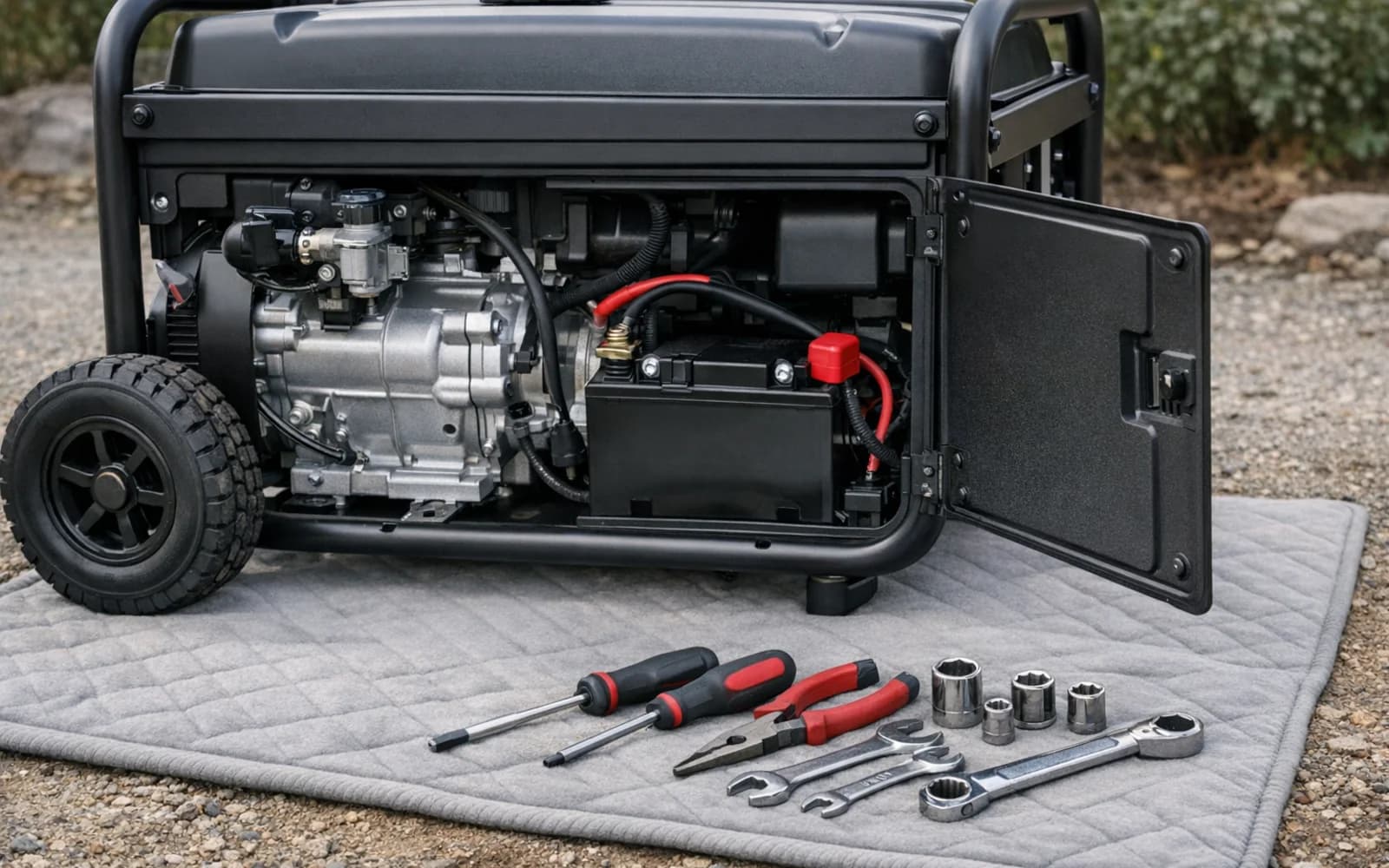
Generator Won't Start: A Troubleshooting Checklist
A symptom-to-cause-to-fix checklist for a generator that won't start: stale fuel, closed valve, choke, low-oil sensor, dead battery, and spark plug.
Installation
Quick answer: Most no-starts trace to fuel, not the engine. Start with the basics: fresh gas, the fuel valve open, the choke closed on a cold start, and enough oil, because a low-oil sensor blocks starting. Then check the spark plug, the battery on electric start, and the carburetor. Never crank or run a generator indoors.
Best for
Owners staring at a generator that won't turn over when they need it, who want the checklist in the order a technician would work it.
Wrong fit
Buyers still choosing a generator. Start with the sizing and cost guides; this page is for machines you already own.
Tradeoff
Nine times out of ten the fix is fuel or a fouled plug you can handle yourself. The tenth is a carburetor or sensor that is worth a small service bill rather than a broken machine.
A generator that will not start almost always fails on something small and boring, and almost never on the thing owners fear. The number one cause is fuel: gasoline that went stale in the tank over months of sitting, a fuel valve someone left closed, or a carburetor gummed shut by the varnish old gas leaves behind. Work the checklist in order, from the cheapest and most likely to the least, and you will find most no-starts in the first three checks.
Before anything else, one rule that is not optional: never crank or run a generator indoors, in a garage, or in any enclosed space, even while you are troubleshooting and even with the door open. The exhaust is carbon monoxide, and it kills. Move the unit outside, at least 20 feet from the house with the exhaust aimed away, before you pull the cord. The full picture is in the generator safety guide.
Quick Answer: The Checklist in Order
Symptom
Likely cause
Fix
Won't start after months of storage
Stale fuel
Drain the old gas, refill with fresh, add stabilizer
Cranks or pulls but never fires
Fuel valve closed
Open the fuel valve (petcock) fully
Won't fire on a cold start
Choke in the wrong position
Close (engage) the choke to start cold, open it once warm
Dead, no crank, engine turns freely
Low-oil shutoff sensor
Check oil on level ground, top up to full
Electric start clicks or does nothing
Dead starter battery
Charge or replace the battery; use the recoil pull-start
Spark seems weak, hard starting
Fouled or worn spark plug
Clean or replace the plug, check the gap
Fresh fuel, still won't run
Clogged carburetor
Clean the carburetor and jet, or have it serviced
Starts and runs but no power at outlets
Tripped breaker or transfer switch
Reset the breaker; check the transfer switch position
Start at the top. Fuel and the fuel valve account for most no-starts, the low-oil sensor is the quiet one people miss, and the carburetor is where a stored generator usually ends up if the fuel was left in it.
Fuel: Stale Gas Is the Number One Cause
Gasoline does not keep. Without a stabilizer it starts to break down and gum up in as little as one to three months, and a generator that sat all year on last season's fuel is the classic no-start. The gas can look fine and still be dead.
Drain the old fuel from the tank into an approved container for proper disposal, refill with fresh gasoline, and add a fuel stabilizer this time so the next tank survives storage. If the machine ran on ethanol-blended pump gas and sat, the ethanol may have drawn in moisture and separated, which is its own starting problem. Fresh fuel is the first thing to try because it is the most common cause and the cheapest fix.
This is also the quiet advantage of a dual-fuel generator run on propane: propane does not go stale, so the year-three no-start pattern largely disappears. More on that in natural gas vs propane.
The Fuel Valve and the Choke: Two Switches People Miss
Two hand controls stop more starts than any broken part, because they are easy to leave in the wrong spot.
The fuel valve, or petcock, has to be open for gas to reach the engine. If someone closed it to run the carburetor dry before storage, which is good practice, the engine will crank or pull all day and never fire until you open it again.
The choke restricts air to make a richer mix for a cold start. Start a cold engine with the choke closed (engaged), then move it to open (run) once the engine is warm and settled. Get it backwards, choke open on a stone-cold engine, and it will not catch; leave it closed after it warms up and it will sputter, load up, and stall. If your generator will not fire cold, the choke is one of the first two things to check.
The Low-Oil Shutoff Sensor: The Quiet One
Most modern generators have a low-oil shutoff that stops or prevents the engine from starting when the oil is below a safe level. It is there to save the engine, and it does its job silently, which is why owners overlook it. If the generator turns over freely but will not start, or dies seconds after starting, check the oil before you blame anything electrical.
Check the oil on level ground, because a unit parked on a slope can read low or trip the sensor even when it is close to full. Top it up to the full mark with the oil grade the manual specifies. If it was genuinely low, running it dry is exactly what the sensor was protecting you from.
Electric Start: A Dead Battery, Not a Dead Generator
On an electric-start unit, a starter that clicks, cranks slowly, or does nothing usually means the starting battery is dead or weak, not that the engine has a problem. Batteries self-discharge in storage and lose capacity over two to three years, and a generator that starts every storm still needs its battery charged and replaced on schedule.
Charge the battery or replace it if it will not hold, and check that the terminals are clean and tight. Most portable electric-start generators also keep a recoil pull-start as a backup, so a dead battery does not have to leave you stranded; you can start it by hand while the battery charges. On a standby, a dead battery is the most common reason the unit fails its transfer test, which is why the battery is a scheduled replacement item in generator maintenance cost.
Spark Plug and Carburetor: When the Basics Check Out
If fuel is fresh, the valve is open, the choke is right, and the oil is full, the problem is usually spark or a clogged carburetor.
A fouled, wet, or worn spark plug gives a weak spark or none. Pull the plug, look for heavy carbon or oil fouling, clean it or replace it, and confirm the gap matches the manual. A cheap plug is worth swapping before you go deeper.
The carburetor is where stored fuel does its damage. As gasoline evaporates it leaves a varnish that clogs the tiny jets, and a clogged carburetor will crank on fresh fuel and still not run, or start and immediately die. Cleaning a carburetor is a doable job for a hands-on owner with a rebuild or cleaning kit, but it is fiddly, and if you are not comfortable pulling it apart, this is the point where a small service bill beats turning a stuck jet into a broken machine. Leaving the tank empty or running the carburetor dry before storage is what prevents this next time.
It Starts, But There Is No Power
A generator that runs fine but delivers nothing at the outlets is a different problem, and usually not a broken engine. Check the generator's own breaker or GFCI outlets first, since an overload trips them and cuts the output while the engine keeps running. If the unit is wired to your house, confirm the transfer switch or interlock is in the correct position, because power will not reach your circuits if the switch is still set to utility. The wiring side is covered in interlock kit vs transfer switch.
Frequently Asked Questions
Why won't my generator start after sitting all winter?
Almost always stale fuel. Gasoline breaks down and gums up in as little as one to three months without a stabilizer, so a generator stored on last season's gas often will not start. Drain the old fuel, refill with fresh gas, and add stabilizer for next time. If fresh fuel does not fix it, the same stale gas has probably clogged the carburetor, which needs cleaning.
My generator cranks but won't fire. What do I check first?
Fuel reaching the engine. Confirm there is fresh gas in the tank, the fuel valve or petcock is fully open, and the choke is closed for a cold start. Those three account for most crank-but-no-fire cases. If they all check out, move on to the spark plug and then the carburetor, which clogs when old fuel is left to varnish inside it.
Why does my generator start and then die right away?
The two usual causes are the low-oil shutoff sensor and a clogged carburetor. Check the oil on level ground first and top it to full, because the sensor cuts the engine to protect it when oil is low. If the oil is fine, a partly clogged carburetor can let the engine catch on the fuel in the bowl and then stall once that runs out, which points to a cleaning.
My electric-start generator just clicks. Is it broken?
Usually it is the battery, not the generator. Starting batteries self-discharge in storage and weaken over two to three years, so a click or a slow crank points to a dead battery. Charge or replace it and clean the terminals. Most portable electric-start units also have a recoil pull-start, so you can start the engine by hand while the battery charges back up.
Can I troubleshoot a generator in the garage if I keep the door open?
No. Never crank or run a generator indoors or in a garage, even with the door open, because the exhaust is carbon monoxide and an open door does not move enough air to prevent a lethal buildup (CPSC). Move the generator outside, at least 20 feet from the house with the exhaust pointed away, before you try to start it, even for testing.
These guides are built from manufacturer documentation, public specifications, primary research where health claims matter, and repeated buyer questions that show up in real ownership and installation decisions.
Manufacturer responses can clarify pricing bands, warranty terms, support footprint, or common mistakes. They do not move a page up the shortlist on their own.