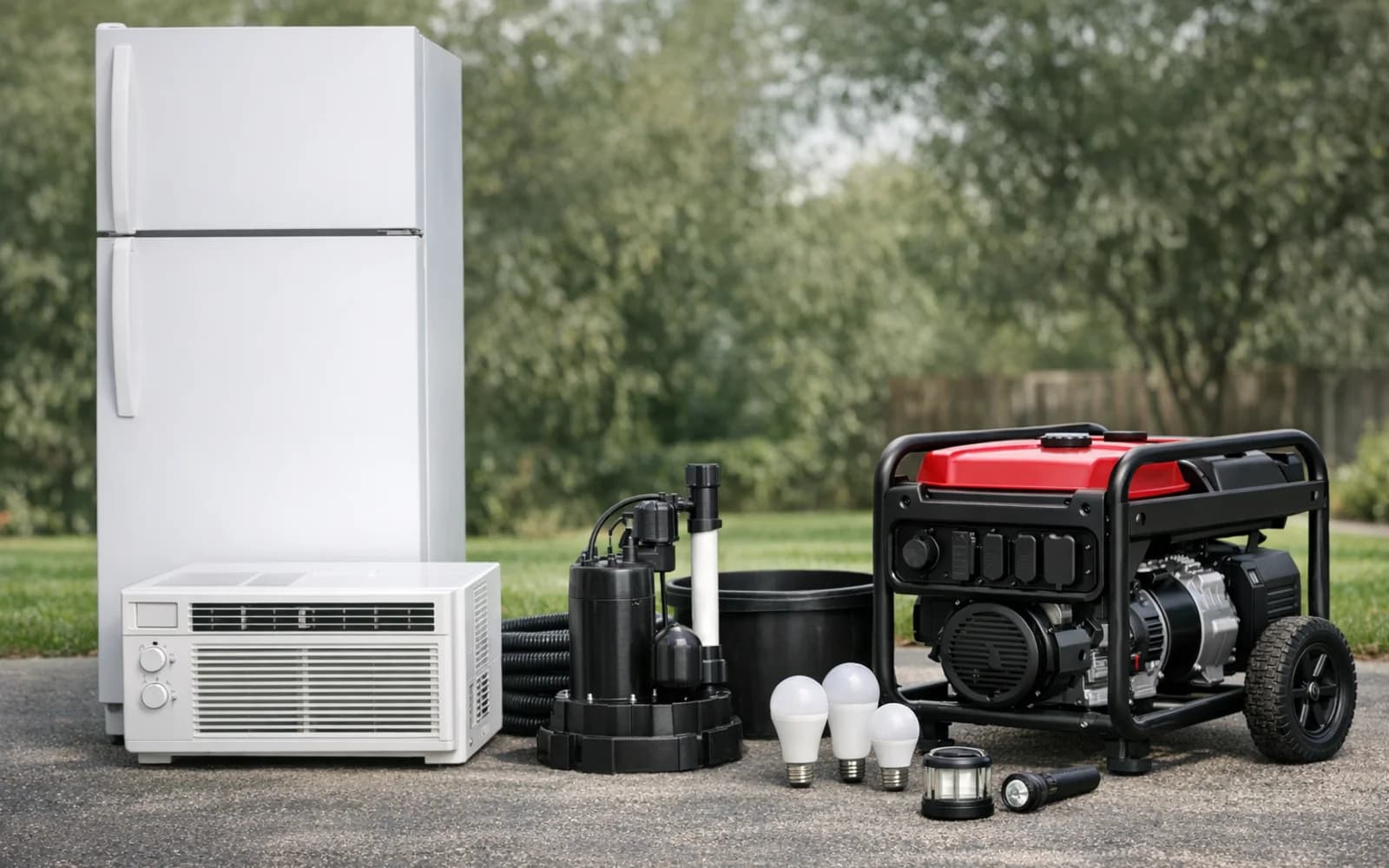
The appliance wattage table, running vs starting watts, and a plain kW-to-what-it-runs chart, so you size a generator to your real load, not a nameplate.
Setup Type
Quick answer: Every appliance has two numbers: running watts to keep it on, and a higher starting surge that motors pull for a second or two. Size a generator to your running total plus the single largest surge. A fridge, furnace fan, lights, and one pump fit a 5,000 to 7,500 watt portable; central air needs far more.
Best for
Buyers who want the actual appliance wattages and a generator-size chart before they add up their load or walk into a dealer.
Wrong fit
Buyers who already know their number and just want the brand shortlist or the installed price.
Tradeoff
Size to running watts alone and a motor surge trips the breaker at 2am. Size to every nameplate added together and you overpay for watts you never draw at once.
Generator wattage comes down to two numbers on every appliance, and only one of them is printed where you can see it. Running watts keep a device going once it is on. Starting watts, the surge, is the extra jolt a motor pulls for a second or two to break free from a dead stop. Size a generator to your full running total plus the single largest surge, and it holds. Size it to running watts alone and it trips the first time two motors kick on together.
This guide gives you the appliance numbers, explains why the surge is the part that bites, and hands you a plain chart of what each generator size can realistically run. If you want the full sizing walkthrough with the three home sizes and the install math, what size generator do I need is the companion page. This one is the reference table you check against your own labels.
Quick Answer: What Each Generator Size Runs
Generator size
What it realistically runs
2,000-2,500 W (inverter)
Fridge, phone and laptop, a few lights, one small item at a time. Not heat plus a motor together.
3,000-4,000 W
Fridge, lights, furnace fan, a sump pump, a TV. One motor load at a time, no central air.
5,000-7,500 W
The essentials: fridge, furnace fan, lights, outlets, and one motor like a well or sump pump, with headroom for its surge.
8,000-10,000 W
The essentials plus a window AC or a well pump with a comfortable margin. Still not central air plus everything.
10-14 kW (standby)
The essential circuits hands-off: heat, water, fridge, some outlets, one AC zone.
18-26 kW (standby)
The whole house, central air included, nothing switched off.
These are planning figures. Your real number depends on which appliances you run at the same time and which motor has the biggest surge. Pick the row that matches what you refuse to lose, not the biggest unit a salesperson can talk you into.
Running Watts vs Starting Watts
Running watts, sometimes called rated watts, is what a device draws to keep going: a fridge holding temperature, a furnace fan pushing air, a string of lights. Add up everything you want on at the same time and that total is your running load.
Starting watts, also called surge or peak watts, is the brief spike some devices need for the first second or two. Anything with a motor pulls far more current to get the shaft spinning from a standstill than it needs to keep it spinning. The spike is short, but if the generator cannot deliver it, the motor stalls and the breaker trips.
The math the spec sheet skips is this: your generator has to cover your full running total plus the single largest surge on top of it. Not every surge at once, because your motors do not all start in the same instant, but the biggest one has to fit with room to spare.
Why surge matters more than the running number
A motor at rest is close to a dead short for a moment. To break free it draws roughly 2 to 4 times its running watts, and the hardest starters spike higher. A well pump or an air conditioning compressor can pull 3 to 5 times its running draw for that first moment (est., it varies by model and load). That is why a 1,000 watt well pump can need 3,000 to 5,000 watts to start, and why a fridge that sips 150 watts all day can ask for over 1,000 at the flick of its compressor.
Resistive and electronic loads behave differently. Lights, a TV, a laptop charger, a microwave, and a space heater draw close to their rated watts with little or no surge. The surge problem is really a motor problem. Count your motors and you have found the number that decides your generator size.
The Appliance Wattage Table
Real ranges, because the exact draw depends on the model, the age, and how hard the motor works. Treat these as planning figures, then check the label or nameplate on your own units. A resistive item like a heater or a water heater shows no meaningful surge; the surge column is where the motors live.
Appliance
Running watts
Starting surge watts
Refrigerator or freezer
100-800
1,000-2,200
Chest freezer
100-400
300-1,000
Furnace fan (blower motor)
600-900
1,300-2,400
Sump pump (1/3 to 1/2 HP)
800-1,050
1,300-2,150
Well pump (1/2 to 1 HP)
550-2,000
2,000-6,000 (est.)
Central AC (2 to 3 ton)
3,500-5,000
very high; a soft start kit helps (est.)
Window AC (10,000-12,000 BTU)
1,200-1,500
2,200-3,600
Electric water heater
3,000-4,500
none (resistive)
Space heater
1,500
none (resistive)
Microwave (1,000 W cooking)
1,000-1,800
little to none
Washing machine
500-1,200
1,000-2,300
Garage door opener
480-720
1,000-1,400
Coffee maker
600-1,200
none (resistive)
LED lights (one room)
60-300
no surge
TV or laptop
60-300
no surge
Two things jump out. Central air and the electric water heater are the giants, which is why they are usually the first loads left off a portable's list or given a soft start kit to tame the inrush. And the well pump has the widest surge range, which is why well owners so often undersize and then wonder why the generator groans every few minutes.
Generator Size to What It Runs
2,000 to 4,000 watts: one job at a time
A small inverter or a compact open-frame unit keeps a fridge cold, a few lights on, and your phone and laptop charged. Around 3,000 to 4,000 watts you can add a furnace fan or a single sump pump, but you are running one motor load at a time and choosing what stays off. This is a "keep the food and the phone alive" size, not a run-the-house size.
5,000 to 7,500 watts: the essentials with headroom
This is the sweet spot for most homes that lose power a few times a year. It covers the fridge, the furnace fan, the lights, a few outlets, and one motor load like a well or sump pump, with headroom for that motor's surge. A 7,500 watt unit gives you room to run the well pump and the furnace without choreographing which one starts when. What it will not do is run central air and everything else at once. If that trade fits your outages, start with the best portable generators for home backup.
8,000 to 10,000 watts: essentials plus one comfort load
The extra headroom lets you add a window AC or run a demanding well pump without living on the edge of the rating. It is still not a whole-house number. Central air plus the water heater plus every other load added together is where you cross into standby territory.
10 kW and up: the standby lane
A permanent standby wired to a transfer switch covers your important circuits hands-off. Ten to 14 kW handles the essentials for most homes: heat, water, fridge, some outlets, one AC zone. Eighteen to 26 kW runs the house the way you live in it, central air included. Most people who ask for whole-house actually want the middle, sized to their real simultaneous load rather than the sum of every nameplate. A whole-house standby lands in the $12,000 to $18,000 installed range, because the install costs about as much as the machine.
How to Add Up Your Number
List everything you want on at the same time. Add their running watts for your base total. Then find the single appliance with the largest starting surge and add that one surge on top. That sum is your minimum, and a sensible target adds about 20 to 25 percent breathing room so the engine is not pinned at its limit.
You do not have to do this on a napkin. Our sizing calculator asks what you want to keep running and returns a target wattage for a portable or a kW range for a standby, plus a rough fuel burn. Confirm the surge on your biggest motor, and you will walk into any dealer or hardware aisle knowing your number before they tell you theirs.
One safety note that rides along with wattage: never power your house by plugging a generator into a wall or dryer outlet, and never exceed the generator's continuous rating. Backfeeding is illegal and can kill a lineman, and an overloaded unit or cord is a fire risk. Connect through an interlock kit or transfer switch installed by a licensed electrician, covered in interlock kit vs transfer switch.
Frequently Asked Questions
How many watts does it take to run a house?
It depends on what you keep on at once, not on the house size. The essentials, a fridge, furnace fan, lights, outlets, and one motor like a well or sump pump, fit a 5,000 to 7,500 watt portable with surge headroom. Running central air and everything at the same time is an 18 to 26 kW whole-house standby. Most homes land somewhere in between, and a 10 to 14 kW standby on the essential circuits covers them.
What is the difference between running watts and starting watts?
Running watts keep a device going once it is on. Starting watts are the brief surge a motor pulls for a second or two to spin up from a stop. Your generator has to cover your full running total plus the single largest starting surge on top of it. Lights, electronics, and resistive heaters use their rated watts with almost no surge, so the surge math is really about your motors.
How many watts does a refrigerator use?
A home refrigerator or freezer runs on roughly 100 to 800 watts once the compressor is up to speed, but the compressor can surge to 1,000 to 2,200 watts for a second or two when it kicks on. Size for that starting surge, not the running number, or the fridge can stall a generator that is otherwise loaded near its limit.
Will a 5,000 watt generator run central air?
Usually not on its own. A 2 to 3 ton central air system runs on 3,500 to 5,000 watts and pulls a large inrush to start the compressor, which alone can exceed a 5,000 watt unit before you add anything else. A soft start kit cuts that inrush and can bring a smaller AC system within reach, but for central air plus other loads you are generally looking at a large portable or a standby.
Should I add up all my appliance watts?
Only the ones you would run at the same time. Add the running watts of everything you want on together for your base load, then add the single largest starting surge on top, and give it about 20 to 25 percent margin. Adding every nameplate in the house together overstates your real draw and pushes you toward an oversized, more expensive unit than your simultaneous load needs.
These guides are built from manufacturer documentation, public specifications, primary research where health claims matter, and repeated buyer questions that show up in real ownership and installation decisions.
Manufacturer responses can clarify pricing bands, warranty terms, support footprint, or common mistakes. They do not move a page up the shortlist on their own.