Generator Buying Guide 2026: Standby, Portable, Sizing and Cost
The full home generator buying decision in one page. Standby vs portable, sizing, fuel, transfer switch, installed cost, CO safety, and what to ask before you sign.
Final Decision
Quick answer: Pick the lane before the logo. If your outages run days, budget $12,000 to $18,000 for a standby project, not the $3,000 to $6,000 machine sticker. If they run hours, a $700 to $2,500 portable plus a $400 to $850 interlock covers it for a tenth of the money. Size from your real loads including motor starting watts, pick fuel by what your house already has, and never connect without a transfer switch or interlock. The order of decisions matters more than the brand.
Best for
Buyers who want the whole decision path in one place before they take a quote or place an order.
Wrong fit
Buyers who only need one narrow answer, like a single sizing question or one brand comparison. The linked deep dives move faster.
Tradeoff
Doing the budget, sizing, and install homework up front takes an evening. Skipping it is how a $9,400 quote becomes a $16,000 invoice, or how a portable ends up on the porch where it can kill someone.
Most people buy a generator backward.
They start with a brand, fall for a spec sheet, and find out later that the install doubles the price, the "12,000 watt" box cannot start the well pump, or the panel has no legal way to accept the power. Then the storm comes and the machine is the wrong machine.
This guide fixes the order. We don't sell generators. We save you from buying the wrong one, and the way to buy the right one is to make six decisions in sequence: outage pattern, lane, size, fuel, connection, and only then the brand. If you only read one page on this site, read this one.
Quick answer: which lane are you in?
Your outage pattern
Best lane
Real all-in cost
Multi-day outages, or medical needs that cannot wait
Those numbers are the honest ones, not the brochure ones. The rest of this guide shows where they come from and how to avoid paying more than you should.
Step 1: Match the machine to your outage pattern
The single most expensive mistake in this market is buying for the outage you fear instead of the outage you get. Pull up your utility's outage history or think back over three years. How often did you lose power, and for how long?
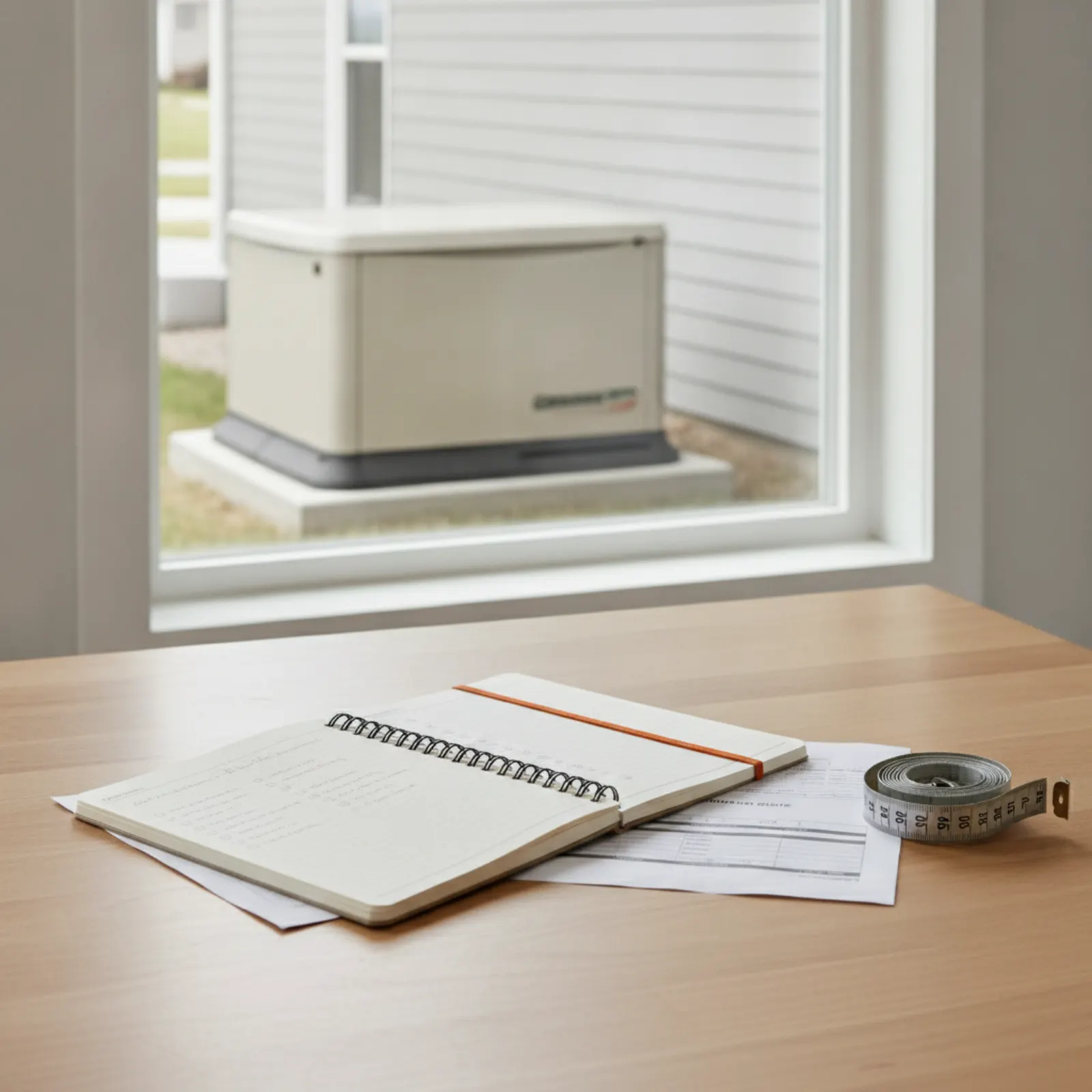
Standby is the answer for long outages. A permanently installed unit on a pad, wired through an automatic transfer switch, running on natural gas or propane. It starts itself, powers the whole house, and runs for days. You pay for that: the project lands at $12,000 to $18,000 installed, and the machine is only half the bill.
Portable is the answer for occasional, shorter outages. A $700 to $2,500 machine you roll out, fuel, and start yourself. Connected through an interlock, it keeps the fridge, furnace blower, well pump, and lights alive. You trade automatic switchover and whole-house coverage for a price a tenth of standby, and for most homes with a few short outages a year, that is the smart trade, not a compromise.
Inverter vs open-frame is a real fork inside the portable lane, and most buyers learn about it after purchase. Inverters run quieter, sip fuel, and produce clean power that is safe for electronics. Open-frame units give you more watts per dollar and more noise per minute. The full tradeoff is in inverter vs open-frame.
A home battery beats both for short outages if silence, indoor placement, or a missing gas line matter. It loses on multi-day outages, where any generator keeps going and a battery runs down. We say that plainly in generator vs home battery, and our sister site homebattery.guide covers that lane honestly from the other side.
Still torn between the first two? Standby vs portable settles it with your outage pattern, not a sales pitch.
Step 2: Size from real loads, not the box
Sizing is where wishful watts live. The number on the box is a surge rating under ideal conditions. Your house does not run on ideal conditions.
The method is simple. List what must run during an outage, add the running watts, then find the single largest motor and add its starting surge on top. Motors are the trap: a well pump, an AC compressor, or a sump pump can draw three to five times its running watts for the second it starts. A generator that covers your running load can still stall the moment the pump kicks on.
Rules of thumb that hold up:
Essentials only (fridge, furnace blower, lights, phones): 3,500 to 5,000 running watts covers most homes.
Essentials plus a well pump: get the pump's horsepower and voltage first. Many pumps are 240V with brutal starting loads, and they push buyers into a larger portable or standby. The specifics are in the well pump guide.
Central air conditioning: a 3-ton unit typically needs 5,000-plus starting watts on its own. If summer outages and AC are the point, you are usually shopping standby, or a large portable with a load-shedding plan.
Whole house, automatically: 18kW to 26kW standby for a typical single-family home, sized by an installer against your panel, not guessed from square footage.
Oversizing hurts too. A standby that never sees half its load still burns fuel on every weekly self-test and costs more up front and at every service. Size for your loads, not your panic. Do the math in what size generator do I need, or let the sizing calculator add the surge watts for you.
Step 3: Pick the fuel your house already argues for
Fuel choice is mostly decided by what your property already has.
Natural gas wins if you have a line: unlimited runtime, no tanks, no refill runs. The catches are a gas line that may need upsizing, sometimes a utility meter upgrade, and the honest caveat that a gas grid failure, rare but real, takes your generator with it.
Propane wins where there is no gas line: it stores indefinitely, and a 500-gallon tank runs a standby for days. You own or rent the tank, you schedule refills, and in a regional emergency the refill truck is busy.
Gasoline is the portable default: available everywhere until the storm, when station pumps lose power too. It also goes stale. Fuel left in a carburetor over the off-season is the top reason a portable won't start the night you need it.
Dual-fuel portables run on gasoline or propane and are the flexibility pick for storm-belt homes. Store propane legally and safely, keep gasoline as the backup, rotate nothing.
Here is the part the spec sheet never mentions: the machine is useless, and dangerous, without a legal way to connect it.
The National Electrical Code (NFPA 70, Article 702) requires transfer equipment that makes it impossible for your generator and the utility to feed the same wires at once. That rule exists because backfeeding, plugging a generator into a dryer outlet with a homemade cord, energizes the utility lines outside your house and can kill the lineman working to restore your power. It can also burn your house down when the grid comes back.
You have three legal options:
Automatic transfer switch, the standby route. It senses the outage, starts the generator, and switches the house over with you touching nothing. Installed as part of the standby project, $2,000 to $5,000 of the total.
Manual transfer switch, for portables. A small subpanel with pre-picked circuits, up to about $1,500 installed.
Interlock kit, the budget hero. A sliding plate on your panel that makes the main breaker and the generator breaker mechanically exclusive. Around $400 to $850 installed, and it turns a good portable into legitimate whole-panel backup, one circuit priority at a time.
Which one fits your panel and budget is exactly the question interlock kit vs transfer switch answers, with the installed prices broken out in the transfer switch cost guide. Whatever you do, budget the connection as part of the purchase. A portable without one is an extension-cord camping kit.
Step 5: Price the project, not the machine
For standby, the install costs as much as the machine. That is the defining fact of this market, and nobody who sells generators leads with it.
Line item
Typical range
Standby machine, 18kW to 26kW
$3,000 to $8,000
Concrete pad and site prep
~$1,000
Gas line sizing, possible meter upgrade
$1,000 to $3,000+
Automatic transfer switch + electrical
$2,000 to $5,000
Permits, inspections
a few hundred dollars
Panel upgrade (older homes)
$1,000 to $3,000
Real all-in
$12,000 to $18,000
Then ownership: $200 to $400 a year for a service contract, a starting battery every two to three years, oil changes, and a weekly self-test your neighbors will hear. The recurring side is detailed in generator maintenance cost.
The portable lane is cheaper and simpler: $700 to $2,500 for the machine, $400 to $850 for the interlock, plus fuel storage. All-in, $1,100 to $3,350 for most homes.
The line-by-line breakdown, including a worked example of how a $9,400 quote becomes a $16,000 invoice through change orders, is in the real cost of a whole-house generator. Read it before you take a quote, not after.
Carbon monoxide: the rules that are not negotiable
This section sells nothing. It is here because portable generator exhaust kills around 85 people in the United States every year, per CPSC data, and the deaths cluster in the days after every major storm. Garage with the door open. Covered porch. Under the bedroom window. All fatal placements.
The rules, straight from CPSC guidance:
Run a portable outside only, at least 20 feet from the house, exhaust pointed away from windows, doors, and vents.
Never in a garage, basement, carport, or crawl space. An open door does not make it safe.
Put battery CO alarms on every level of the house and outside sleeping areas before your first outage.
When you buy new, choose a model with a CO shutoff sensor, listed to ANSI/PGMA G300 or UL 2201. CPSC analysis found UL 2201-compliant units, which pair a shutoff with lower emissions, avert nearly all of these deaths. Most quality 2026 models have it.
Pricing the machine instead of the project. The $6,000 standby that becomes $16,000 installed. Always budget all-in.
Believing surge ratings. "12,000 watts" on the box can mean 9,000 running watts, and less at altitude or in heat. Size from running watts plus the largest motor's start, per the wattage guide.
Skipping the interlock. No legal connection means extension cords through a window, or backfeeding. Budget it with the machine.
Ignoring noise. An open-frame portable runs around 70 to 80 dB, a lawnmower next to your patio, and some HOAs and campgrounds ban them outright. Check the noise guide before you buy, not after the first complaint.
Buying in the panic window. Storm-week prices climb, stock vanishes, and judgment gets worse. Buy in the calm season, and if a storm is already named, read the hurricane prep guide for the honest last-minute playbook.
The longer list, told through owners' own regrets, is in generator buying regrets. Cheaper to read than to repeat.
What to ask before you sign
The full version of this section now lives on its own page: what a standby generator quote must include lists all 16 line items, the verified permit fee in eleven jurisdictions, the manufacturer's gas-pipe sizing table, and the contract terms to settle before you sign. The short version, for a standby quote, is these seven questions:
Is this quote based on a site survey, or from photos? Only the first one holds.
What gas line work is included, and what happens if my meter needs a utility upgrade?
Is the transfer switch whole-house or a managed load center, and why that choice for my panel?
Are permits and inspection included in this number?
What exactly triggers a change order, and can you cap it?
What does the maintenance contract cost, and is it required to keep the warranty?
Who shows up for warranty service, you or a subcontractor, and how fast after a storm?
Already holding a quote and not sure it is fair? Send it through our free quote second-opinion. We read it line by line and tell you what is missing, what is padded, and what to push back on. We do not sell installs, so the answer is straight.
Frequently Asked Questions
What is the best generator for home backup?
The one that matches your outage pattern. Multi-day outages point to an 18kW to 26kW standby, $12,000 to $18,000 installed. A few short outages a year point to a $700 to $2,500 portable with a $400 to $850 interlock. Short outages with noise rules or no gas line point to a home battery. Lane first, then size, then brand.
How much should I budget for a whole-house generator in 2026?
$12,000 to $18,000 all-in for a typical 22kW to 24kW project. The machine is $3,000 to $8,000, and the pad, gas line, transfer switch, permits, and two trades make up the rest. Any quote given without a site survey will move.
Can I just plug a generator into a wall outlet?
No. That is backfeeding, and it can kill a utility lineman, fry your appliances, and start a fire when the grid returns. The legal options are an automatic transfer switch, a manual transfer switch, or an interlock kit, starting around $400 to $850 installed.
What size generator do I need to run my whole house?
For automatic whole-house coverage, most single-family homes land at 18kW to 26kW standby, confirmed by an installer against your panel and gas supply. A portable can cover the essentials, roughly 3,500 to 7,500 running watts, if you manage the largest motor loads one at a time.
Is a portable generator with a CO sensor worth it?
Yes, and it should be a requirement on any new purchase. Models listed to ANSI/PGMA G300 or UL 2201 shut down when carbon monoxide accumulates near the unit. CPSC analysis found the UL 2201 combination of shutoff plus reduced emissions averts nearly all generator CO deaths. The sensor does not replace the 20-foot rule. It backs it up.
Should I get a home battery instead of a generator?
If your outages are short and infrequent, and silence or indoor placement matter, a battery is a real answer at $10,000 to $30,000 installed. For multi-day outages, a generator wins because it refuels and a battery runs down. Our honest side-by-side is in generator vs home battery.
These guides are built from manufacturer documentation, public specifications, primary research where health claims matter, and repeated buyer questions that show up in real ownership and installation decisions.
Manufacturer responses can clarify pricing bands, warranty terms, support footprint, or common mistakes. They do not move a page up the shortlist on their own.
Health and safety pages are written conservatively. When the safer answer is to slow down, get clearance, or skip the heat, that is the answer we give.